Showing posts with label Holdorf. Show all posts

Thursday, November 4, 2010

Past vs Present - Part II

When I see pictures of unpaved roads and what 21st Century Germans and Americans would consider to be rather primitive housing conditions, I have to remind myself that many of the same conditions existed here 150 years ago. It wasn't all that long ago, that transportation was by horse and carriage (if you were among the lucky) and indoor plumbing was uncommon -- especially in rural areas. Coming to America could, in some cases, mean exchanging one set of undesirable conditions for another. Add into the mix a new language, hostility toward new immigrant groups, a country recovering from deep divides between north and south and I find myself in awe of my ancestors.

When Bill and I went to Germany, we were fortunate to be introduced by Werner Honkomp to the Mayor of Holdorf, Bernard Echtermann. He gave us a copy of a book, written in German of course, that chronicled the history of the region. These pictures give you a better feel for the area in the early 1900s.


This is a picture of Holdorf's Main Street. Note the church steeple on the right. This is the steeple of St. Peter and Paul's Church. The street is now much wider, the trees are no longer there, and the street is paved. The first picture below on the left shows the buildings that replaced the two on the left side of the street that burned down. The picture on the right shows the current street scape leading up to St. Peter and Paul Church.


Very close to Holdorf is a farming community called Fladderlohausen. Pictured in the book was a Heuerhaus from that community.


Another picture from the book shows a shoemaker making and wearing wooden shoes. Unfortunately, the picture is a little overexposed, but if you look carefully you can see the shoes. Holdorf is not far from the Netherlands and wooden shoes were part of the common attire. We were told that on Sunday mornings it could get quite noisy in the Church as parishioner after parishioner "clopped" their way to their pew.

Past vs. Present - Part I

One of the things that was most surprising to us was how the Heuerleute (non-landowning workers) live. Often they lived in what was called the Heuerhaus. This was often not much more than a barn that housed the farm animals as well as one or two families of workers. We were able to see one of the two Heuerhauses of the Lampe-Gossling farm. The one that is pictured with a red arrow, points out the location of the "haus" that had burned down and been replaced by a modern building. The black and white pictures were taken in 1930, fifty years after the Vonderheides emigrated.

We were able to see first-hand the surviving Heuerhaus, just down the street from the center of town and the Church. I am pictured with Werner and Mayor Bernard Echtermann who graciously toured the town with us.


Werner explained to us that each completed building included a carving by the main builder/architect. If you notice, you can see that this building was constructed in 1822.


We opened the door to the building and viewed what had been stalls for the farm animals. The farm owner lives in a thoroughly modern home and this building now functions as an outbuilding. I'm sure 150 years ago, the floor was not concrete.


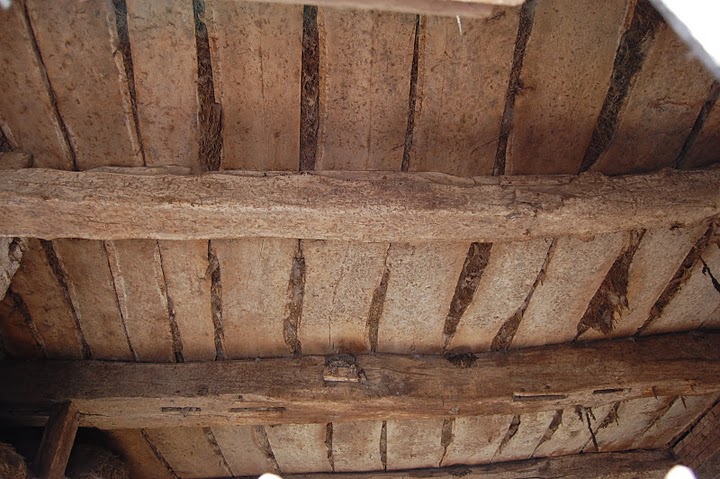
The original hand-hewn beams are visible and a tribute to the architecture of the time.


Not far from Holdorf in Cloppenburg (about 30 miles) an outdoor museum is located where many of the buildings from that era have been moved and preserved. It includes windmills, carriages, farm equipment, and living spaces so that visitors can visualize just how people of the time lived. I was especially interested in the kitchen area. Pictured below is one example of a kitchen built at one end of a Heuerhaus. Fire was a constant threat.


One common site throughout this area of Germany was a shrine with a crucifix as if the farmers were asking God's blessing upon their farms and homes. The Lampe-Gossling Farm was no exception. Here is their shrine, just outside the current family home.


Note: The black and white pictures on this post and several that follow are taken from a book on the history of Holdorf called Die Gemeinde Holdorf im Wandel der Zeit, ISBN: 978-3-86595-162-5 http://www.geigerverlag.de

Holdorf, Oldenburg, Germany

Three years ago, Bill and I had the privilege of traveling to Germany. At the time, our nephew and his wife, Christopher and Sarah were living in Frankfurt. In addition to exploring the beauty of the entire country (plus parts of Denmark), we had two primary goals: 1) visiting the home of our von der Heide ancestors in Holdorf, and 2) attending Oktoberfest with Chris, Sarah and their friends in Munich. As I look over the pictures and information collected when we were there, I long to go back. What a beautiful country!

When you travel to the "homeland", you constantly have to remind yourself that although you may be walking the same streets, it is NOT the same place. Holdorf today is a modern, up-to-date small town in northwest Germany in a country that is part of the European Union. When our ancestors lived there, Germany as a country, was just beginning to exist as a unified country.

Our ancestors came from the Duchy of Oldenburg. If you look at the naturalization papers of "Henry Vonderheide" (first and last name Americanized), Henry renounced his allegiance to the "Grand Duke of Oldenburg and the Emperor of Germany." Henry was 47 years old when he appeared in the Mayor's Court in Covington, Kentucky on November 2, 1886. He had been in this country for five years.

When Henry and his wife, Elizabeth, and their three children left Holdorf, they were near the end of a massive migration from this area to the United States. Werner Honkomp, mentioned in the previous post, helped me discover the von der Heide history in Oldenburg. I've attached a copy of the document he prepared for me. (You can probably enlarge it by clicking on the document. If you are a family member and want a copy, leave a message in the comments section and I'll try to accomodate you).


Interestingly, when a child was baptized in the Catholic Church at that time, the priest often recorded the name of the farming community where the parents lived. At times you could tell from the baptismal record if the parent was a land owner, had a cottage or worked was a non-landowning hired-hand (Heuerleute). From these records we know that Hermann Henrich (Henry) vdH was Heuerleute by Colon gr. Bolling in Holdorf at the time of his marriage. (Colon means big farmer).

Sometime between 1870 and 1873 when "Henry" and Elizabeth were having their children, they relocated to the Heuerhaus of the Lampe-Gossling farm. That farm still exists and is located right on the Gross-Strasse (Main Street) of Holdorf. The next post will include pictures of the two possible places where the young Vonderheide family lived before making the decision to emigrate.