Showing posts with label diphtheria. Show all posts

Saturday, February 5, 2011

James N. Ryan - The Unthinkable Happens

On May 1, 1911 twenty-two year old James Nicholas Ryan died -- of diphtheria.  Just four months shy of fulfilling his commitment to the Navy, he died of a disease that most of us don't even know existed.  We are vaccinated against it as babies.  His parents got the telegram that no parent ever wants to get.


Cincinnati Enquirer, May 2, 1911

Along with the telegram came disbelief. Jim's father could not accept that his young, healthy son was dead. There had to be some "other" explanation than the "official" one. Newspaper articles of the time reflect this confusion. Despite a Death Certificate that clearly states the cause of death as , the article states that "it was stated by some naval officials that there is some doubt as to the cause of Ryan's death." When contacted by the Enquirer, the officer in charge on the Virginia stated that "Ryan died of natural causes" but then added that he "did not care to discuss it."


Cincinnati Enquirer, May 2, 1911

It's no wonder the father questioned the cause of death. The telegram received by the parents simply stated:

"Your son, James M. Ryan, died suddenly this afternoon. Wire as to disposition of remains."  

I can't imagine getting a telegram telling me about the death of my firstborn-son and namesake that seems so matter-of-fact and unfeeling.  I would be in shock.  He was determined to get to the bottom of this. (You can click on the article to enlarge it).


Cincinnati Enquirer, May 4, 1911, p.4


The article states that Jim's death was due to heart failure, owing to diphtheria. It also adds that Ryan had been sick with diphtheria for five days, a fact reflected in Jim's service record. However, members of the crew stated that Jim was "up and around the ship an hour before his death." One officer stated Ryan "was ordered to the sick bay at 12:20 and died at 1:05." Reports such as this probably led to the speculation that Jim died by choking on tobacco. (See next clip)
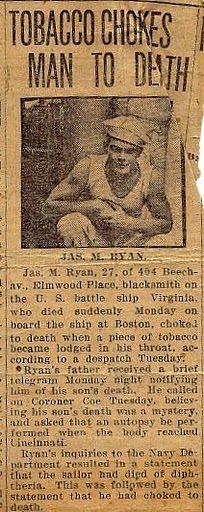


I've not been able to ascertain the source of this article, but it contains a few errors. It lists Jim's age as 27 and his middle initial as an "M'. It attributes Jim's death to choking on a piece of tobacco that became lodged in his throat.  However, the article goes on to state that "Ryan's inquiries to the Navy Department resulted in a statement that the sailor had died of diphtheria.  This was followed by a statement that he had choked to death."


I think the evidence is overwhelming.  Jim died of diphtheria.  Everyone agrees that he was ordered to sick bay in the last hour of his life.  No one goes to sick bay for an hour to choke to death on tobacco.   It's hard for us to accept 100 years later that someone so healthy and young could die of a bacterial infection that we are vaccinated against and that can be cured by an antibiotic.  Yet antibiotics did not yet exist.  Needless to say, the family was devastated.

Tuesday, February 1, 2011

James Nicholas Ryan - A FollowUp

Last April, I wrote a post on James Nicolas Ryan, the first-born child of James Hugh and Rose Ryan. In that post I mentioned that I was going to send away for James service record from the National Archives to clear up some "myths" about Jim.  Jim (as he was known) died at the age of 22 aboard the USS Virginia while it was docked in the Boston Harbor.  Cause of death -- diphtheria.

Jim Ryan is sitting on the right of the anchor.
The stories about Jim had become quite grandiose over the years.  I referred to him as "St. James." With each telling of the story, Jim became more and more heroic. His stature increased, he advanced quickly through the ranks, and they even named a building after him in Washington, D.C.  The most consistent story is similar to one that Pat Biederman, a niece of Jim, sent me in an email:
While the fleet was on their voyage a piece broke on the ship and Jim said if they could get a fire hot enough to melt brass he could fashion the piece.  He made the piece that was needed.  He is listed in the National Archives in Washington D.C. as inventing the first forge on the high seas.
I just had to separate the fact from the fiction. A couple of months ago, I sent for Jim's record from the National Archives.  The record was much more comprehensive than I had anticipated.  We had always known that Jim "lied" about his age when he joined the navy at age 18.  He gave his age as 21.  This eventually resulted in his Death Certificate incorrectly listing his age at the time of death as 25 when he was only 22.  (The Navy did identify the discrepancy in reports following his death and attributed the discrepancy to an incorrect age at the time of enlistment).  Jim was the oldest of nine children and I'm sure it was to his advantage to move out as soon as possible.  Pictured is part of his enlistment record.  I especially like seeing his signature and knowing once and for all how he spelled "Nicholas".  I'm going to have to update some records.


Note the description of his physical characteristics:  Age - 21 years 2 months (not true), Height - 5 ' 8 3/8", Weight - 156 pounds, Eyes - hazel, Hair - dark brown, Complexion - ruddy and Personal characteristics, marks, etc. - scar over each eye, r. knee, r. ring finger, tip r. index, wart inside l. hand.  In a separate document, his occupation at the time of enlistment is listed as "moulder" and later reports include a tattoo of the head of a sailor on his left arm.

Of interest to me was the inclusion in the record of a "report card" documenting Jim's competence on the job, changes in rank, commendations and punishments.  Hopefully, the reader will be able to click on the documents below and enlarge them.


If you review the documents, clear patterns emerge.  Jim was generally "proficient" as a sailor averaging a "4" on a 5-point scale.  You could also conclude that he was "sober".  His "mechanical ability" and competence with "marine equipment"  improved over time from a rating of "1" to a rating of "4". 

On the other hand, it seems as if Jim occasionally struggled with authority. Almost immediately after enlisting, Jim was found guilty of "leaving his station without permission,"  an offense that merited him five days of solitary confinement. For the next nine months, Jim "kept his nose clean," but then he overstayed his leave by three hours and was bumped back a class. Over the next year and a half, Jim frequently overstayed his leave and was given extra duty, reduced a class or docked pay.  He was caught "smoking out of hours" and found guilty of "using indecent language when told to get in uniform."  This latter offense earned him another day of solitary confinement.

1910 was a good year.  Jim was promoted to "Fireman - 2nd Class" and then "Fireman - 1st Class" six months later.  Almost immediately he was reclassified as a "Blacksmith (foundryman)" probably following his ability (so often referenced in the oral history) to fix a critical piece of the ship based on his experience as a "moulder,"  This was the rank he held at the time of his death in May, 1911.  Listed below is a summary of Jim's ranks during his time in the Navy.


Luckily for us, we have more than Jim's Navy records.  In the next posts, I will post some of Jim's personal notes that are a part of Matt Biederman's collection.