Showing posts with label Vonderheide. Show all posts

Sunday, May 5, 2013

Settlers and Builders of Ohio


Since I became interested in genealogy 13 years ago, I've taken advantage of several opportunities to document my ancestors. In addition to blogging, one of the ways I have done this is by submitting my findings to various lineage groups sponsored by the Hamilton County Genealogical Society and the Ohio Genealogical Society.

I have two main reasons for doing this. First of all, it forces me to improve as a genealogist. I must submit my records for peer review -- and I can assure you it is not always an easy process. Often one of the reviewers will request supporting documentation. In some cases, I've been forced to explore records previously unknown to me. However, once accepted, I had a real feeling of accomplishment that I had preserved my family's history for those who come after me.

Secondly, both organizations preserve my application and supporting documentation. Should something happen to me and all of my documentation be destroyed, it is good to know that all Hamilton County records are being preserved at the Cincinnati History Library and Archives and that those submitted to the Ohio Genealogical Society are preserved at their library.

So far I have had ancestors accepted into three Hamilton County lineage groups: Century Families, Settlers and Builders and First Families, and three Ohio Genealogical Society lineage groups: Century Families, Settlers and Builders, and Civil War. I would still like to submit three more ancestors for the Civil War group and an application for First Families to OGS. If I get really brave, I may even try to submit to the Daughters of the American Revolution because we should qualify through our Wainright line. I'm most proud of our First Families award because I had to prove that we had direct ancestors living in Cincinnati or Hamilton County before December 31, 1820. William and Ruth Wainright and their son, Britton, qualified.


One thing I know for sure -- I am a descendant of a very diverse English, Irish, German and Welsh family including one who fought in the Revolutionary War (Vincent Wainwright) and one who arrived from Germany as recent as 1881 (August Vonderheide). I am proud to know them all.

Sunday, August 14, 2011

"Our" Vonderheides in the Ships Passenger Lists

Since I started researching the Vonderheide branch of my family (maternal g-grandparents) ten years ago, I was amazed that I could not find this family listed on any ship's passenger list or other common resource such as Germans to America. After all, I knew exactly when the family came through Baltimore on their way to Cincinnati from written family records, naturalization papers and census documents. I chalked it up to the many variations for Vonderheide in the records. I've found this surname listed as: v d Heide, Heide, von der, Heide, von der Heide, and several other variations.
 
Recently, however, one of the members of our local genealogical society published an article containing a ship's passenger list that included Vonderheides from Holdorf, Germany who emigrated to Cincinnati in 1852. They were the aunt and uncle of "my" Vonderheides who did not arrive until 1881. Encouraged by her article, I decided to try again. This time, I think I hit pay dirt. I wonder if you agree with my conclusions.

I searched ancestry.com for passenger lists to Baltimore for June 1881. Scrolling through the document page by page, I found this image:


Click to enlarge

I then looked to see what the transcription was for this record:


Click to enlarge

My Vonderheide family of 1881 included Hermann Heinrich (age 42), Elisabeth (age 43), Joseph and Heinrich (Henry) twins (age 11) and August (age 7). The ages for the parents were correct. Elisabeth could have had the nickname of Liselle. What was clearly "Heinr." on the original record was transcribed as "Heiur", and "August" was transcribed as "Margurt". The poor transcription of the names was understandable, but the ages were clearly wrong. And how did they EVER decide that their surname was HeideHeide?


I'm not surprised that the people responsible for recording the names of the people in steerage were not too concerned about getting the ages of the children correct. Everything else fits. I think I finally found them! In addition, I now know that they came over on a ship called the Leipzig.

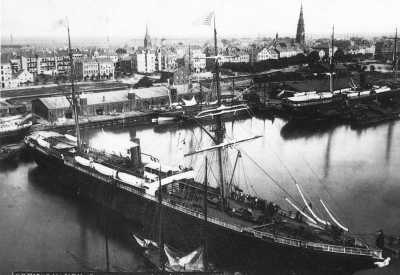
S.S. Leipzig
Photo Credit:  Palmer List of Merchant Ships

According to the Palmer List of Merchant Ships:


The steamship LEIPZIG was built for Norddeutscher Lloyd by Caird & Co, Greenock, Scotland (yard #149), and was launched on 13 February 1869. 2,388 tons; 91,68 x 11,89 meters (length x breadth); clipper bow, 1 funnel, 2 masts; iron construction, screw propulsion, low-pressure, single expansion engine, 1,150 hp, service speed 10 knots; accommodation for 84 passengers in 1st class and 735 in steerage.
You can read more about it by clicking on this link.  Search under "L" for "Leipzig." Lesson learned -- don't stop searching too soon.

Saturday, November 6, 2010

Cousins in Germany


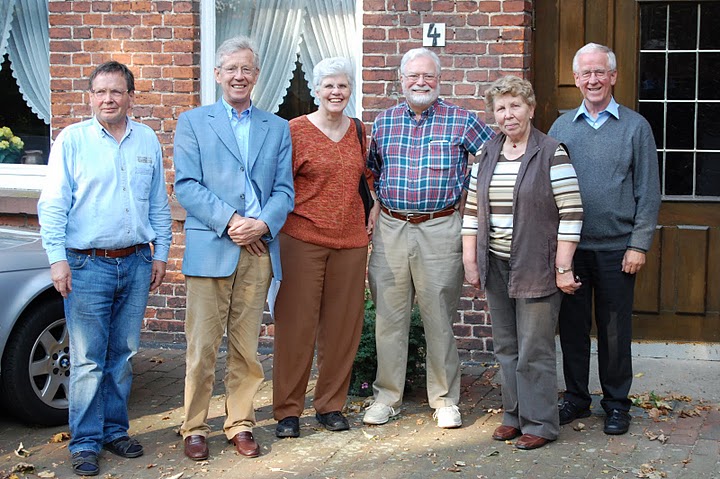
Alois, Heinrich, Kathy, Bill, Mathilde, Hubert

In an earlier post, I told you that our friend and local genealogist, Werner Honkomp. Werner met us where we were staying in Holdorf and took us on a full-day tour of the area. In the afternoon, he had a special surprise. He took us to the home of Alois von der Heide. Alois lived in a home that had once belonged to a von der Heide who married a Borgmann. His brothers Heinrich and Hubert, and his sister, Mathilde also came. Werner suspected that we might be related.

There is no way to describe how much we enjoyed this. We suffered from a bit of a language barrier, relying on Werner to translate. They explained to us that in this region of Germany, even German is a second language. They grew up speaking Plattdeutsch (often referred to as low German). Alois had prepared numerous pictures and documents for us to take with us. The family verified for us that the family plot we had photographed in the cemetery was their family plot. We were given copies of correspondence to their Borgmann family that had relocated to Cincinnati. Upon return I was able to verify that this branch of the family was related to Jim Borgman, editorial cartoonist. In addition, we are (as suspected) distant cousins sharing a ggggg-grandfather.


Alois gave me a picture of the house and identified the people in it. I know the picture is hard to make out, but the picture is the family of Heinrich von der Heide and Joanna Borgmann. Their daughter, Mathilde, is looking out of the window on the left. Son, Heinrich, is on the horse with his brother, Franz, standing nearby.


Alois, Mathilde, Heinrich, Hubert, Werner and me sharing family documents.

Alois shared two additional pictures that had been in his family. We were told that the first picture was of the Borgmann/von der Heide family and I recognize the man in the upper left as Ben Borgmann who came to Cincinnati. The woman to his right is his wife, Catherine Pirron. I think this picture may have been taken in Cincinnati in 1896 and returned to the family in Germany. (Note: This information was updated on 8/28/2018 by Diana Roehm. Diana is Ben and Kate's granddaughter). Ben is holding Catherine Borgmann Sellhorst, his younger sister. His wife is Catherine (Kate) Pirron.  Diana also thinks the man on the top right is August (Gus) Borgmann, brother of Ben. His wife (to the left) was Anna Josephine Janszen. Harry is sitting in front of Gus. The couple in the middle is August Borgmann Sr. and his wife, Bernardine Von Wahlde Borgmann to his right.  Diana thinks that the woman to the left of August Sr. is Frederica (Ric). From left to right, the children in the bottom row are Mary Ann, Frank, and Bernardine.


I am unsure of what occasion is reflected in the next picture. Unfortunately, Alois did not know the names of those pictured. He did, however, circle one face on the back of the picture. It jumped out right away. I don't know who it is, but recognize that "von der Heide" look.


Look at the pictures of five von der Heide men below. Is it just me or do you see similarities in facial structures. Post your answer in the comments section.


By the way -- the identities of the von der Heide men are as follow: Hubert (a Catholic priest), Heinrich (holds a position in Cologne similar to a city councilman), our g-grandfather August, August as a young man, and unknown von der Heide in Germany.

I want to acknowledge Werner, pictured on the left, without whom none of this would have been possible. He has patiently answered my questions and those of many others tracing their genealogy in this region. I will forever be grateful to him.

Friday, November 5, 2010

Earlier Generations


Hermann Henrich "Henry" VDH was born on March 17, 1839 in Holdorf-Ihorst. I've included a map that shows how close the farming communities were in relation to each other. He was the son of Gerhard Henrich VDH and Maria Catharine Ortmann. (It was traditional in that part of Germany to give a child several names. They were typically "known by" the last name in the list. Gerhard Henrich was born in 1802 in Dinklage and Anna Catherine was born in 1802 in Damme. Damme is a few miles southeast of Holdorf and just off the map.

The earliest records I have for the von der Heides has them living in the Dinklage area. Since all of these towns were within a few miles of each other, we visited each of the communities and the churches where they were probably baptized. The church pictured on the left is the one in Dinklage. The one on the right is St. Victor in Damme.


Once again the baptismal records list the family as "Heuerleute" working as hired hands on the farms of others. The book on the history of Holdorf included pictures of farm families in the early 20th Century. This generation worked the farms a century earlier. They generally had large families and just surviving was a full-time job.


Henry's Uncle Hermann, brother of Gerhard Henrich, emigrated to Cincinnati a generation before Henry and Elizabeth came with their young family. His uncle probably paved the way and made the transition easier. My Vonderheide g-grandparents are buried in St. Joseph Cemetery Old -- the German cemetery located on the west side of Cincinnati.


This is the grave marker for Hermann "Henry" Vonderheide, father of August, Joseph and Henry.


This is the grave marker for Catherine Elizabeth Kamphake Vonderheide, mother of August, Joseph and Henry. They were the first Vonderheides in my direct line to come to America.

Cemeteries


When you return to the homeland of your ancestors, you want to try to understand as much as you can about their lives. Ironically, that often means learning as much as you can about their deaths.

Armed with great documentation of my German ancestors I wanted to visit the farms where they lived, the towns where they worked and shopped, the churches that were the center of their lives, and of course, their graveyards.

The Germans have different traditions about burial and graveyards than we do. It wasn't hard to find the "current" cemetery where residents of Holdorf are buried. Yet when we asked Werner where it was likely that my ggg-grandfather was buried, he pointed to the paved terrace surrounding the church. At one point, the graveyard for church members occupied the area just outside the church which had been surrounded by a rock wall. Werner remembered the graveyard being dug up when the church updated its heating and air conditioning systems. The rock wall came down and brick pavers now surround the church. If you look carefully at this wedding picture from 1938, you can see what was the church cemetery beyond the far wall.

In Germany, gravesites are not "permanent." Often they are rented for a period of 20-30 years. In the Holdorf area, many of the plots are family plots. Family members are expected to maintain the site. There is no such thing as "perpetual care." If descendants move away or emigrate, it is not long before the plot is "recycled" for use by another family. The goal of burial is for the body to decompose as quickly as possible and the science of decomposition is studied. There has been some concern lately about "waxy" bodies that have resisted decomposition and the Germans are looking for solutions to this problem. for an interesting article on this issue, click on this link: Waxy Bodies

Even monuments are not permanent. Bill and I spent about an hour in the Neuenkirchen Cemetery looking for a monument that had been placed in honor of his cousin, Fr. Joseph Duerstock. He was the long-time pastor of Old St. Mary Church in Over-the-Rhine. Another genealogist even sent me a picture of this large memorial. It has now been removed.

Going through the Sts. Peter and Paul Cemetery, we saw many family plots with surnames that are common in Cincinnati. These include: Rehling, Borgerding, Wolkerding, Ortmann and Hilgefort. Bill has Hilgeforts in his line. We found that descendants of the von der Heides and Hilgeforts lived in the same farming community in the 1850s.

I started this post with the family part for "Heinrich von der Heide" -- one of our family names. Little did I know when I took the picture that we would later meet the family who owns this plot. Better yet -- we are "cousins"!

Thursday, November 4, 2010

The Role of the Church


One of the things that amazed me was the beauty of the churches. These were rather small communities and I could not believe the architecture and intricacy of the altar pieces and stained glass windows. As it ended up, much of the land was owned by the Church. The peasants were landless and farmed the land, paying rent to the Church. This guaranteed a steady source of income.


In present day Germany,churches are supported by a "Church Tax." The following explanation was found on wikipedia:

About 70% of church revenues come from church tax. This is about 8.5 billion (in 2002).

Article 137 of the Weimar Constitution of 1919 and article 140 of the German Basic Law of 1949 are the legal basis for this practice.

In Germany, on the basis of tax regulations passed by the communities and within the limits set by state laws, communities may either

  • require the taxation authorities of the state to collect the fees from the members on the basis of income tax assessment (then, the authorities withhold a collection fee), or
  • choose to collect the church tax themselves.

You can follow the links for a more comprehensive explanation.

Werner told us that many in Germany choose not to be a part of a church to avoid paying the tax. However, if you do not belong to a church, you may not get married, buried or participate in other religious functions of the church. You pay or you don't play.

The original Sts. Peter and Paul Church was constructed in 1827. Previously, residents of Holdorf attended church in the nearby town of Damme. The original church was very simple by comparison to the new one. The nearby town of Steinfeld applied for a grant and was able to tear down and rebuild the church for a multi-purpose use. One floor of the former church is a tannery museum. After the new church was built, there was a period of time when the building was used as a tannery. The second floor houses local records, a meeting room and is part of the Historical Society. Werner's nephew is mayor of the town and took us on a tour of the building.

Interestingly, the original doors of the church were recovered and are now on display on the second floor. They had served as doors to a tavern for many years.


I was so happy to see the baptismal font so prominently situated in Sts. Peter and Paul Church. I have every reason to believe that my g-grandfather, August, and his siblings were baptized at that very font.

Past vs Present - Part II

When I see pictures of unpaved roads and what 21st Century Germans and Americans would consider to be rather primitive housing conditions, I have to remind myself that many of the same conditions existed here 150 years ago. It wasn't all that long ago, that transportation was by horse and carriage (if you were among the lucky) and indoor plumbing was uncommon -- especially in rural areas. Coming to America could, in some cases, mean exchanging one set of undesirable conditions for another. Add into the mix a new language, hostility toward new immigrant groups, a country recovering from deep divides between north and south and I find myself in awe of my ancestors.

When Bill and I went to Germany, we were fortunate to be introduced by Werner Honkomp to the Mayor of Holdorf, Bernard Echtermann. He gave us a copy of a book, written in German of course, that chronicled the history of the region. These pictures give you a better feel for the area in the early 1900s.


This is a picture of Holdorf's Main Street. Note the church steeple on the right. This is the steeple of St. Peter and Paul's Church. The street is now much wider, the trees are no longer there, and the street is paved. The first picture below on the left shows the buildings that replaced the two on the left side of the street that burned down. The picture on the right shows the current street scape leading up to St. Peter and Paul Church.


Very close to Holdorf is a farming community called Fladderlohausen. Pictured in the book was a Heuerhaus from that community.


Another picture from the book shows a shoemaker making and wearing wooden shoes. Unfortunately, the picture is a little overexposed, but if you look carefully you can see the shoes. Holdorf is not far from the Netherlands and wooden shoes were part of the common attire. We were told that on Sunday mornings it could get quite noisy in the Church as parishioner after parishioner "clopped" their way to their pew.

Past vs. Present - Part I

One of the things that was most surprising to us was how the Heuerleute (non-landowning workers) live. Often they lived in what was called the Heuerhaus. This was often not much more than a barn that housed the farm animals as well as one or two families of workers. We were able to see one of the two Heuerhauses of the Lampe-Gossling farm. The one that is pictured with a red arrow, points out the location of the "haus" that had burned down and been replaced by a modern building. The black and white pictures were taken in 1930, fifty years after the Vonderheides emigrated.

We were able to see first-hand the surviving Heuerhaus, just down the street from the center of town and the Church. I am pictured with Werner and Mayor Bernard Echtermann who graciously toured the town with us.


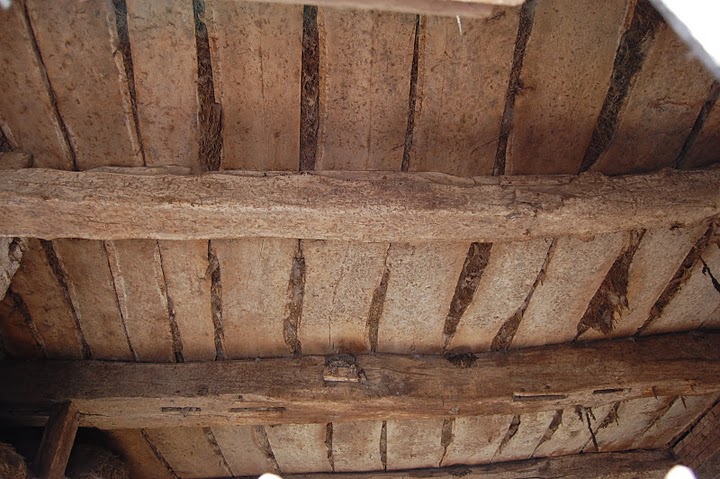
Werner explained to us that each completed building included a carving by the main builder/architect. If you notice, you can see that this building was constructed in 1822.


We opened the door to the building and viewed what had been stalls for the farm animals. The farm owner lives in a thoroughly modern home and this building now functions as an outbuilding. I'm sure 150 years ago, the floor was not concrete.


The original hand-hewn beams are visible and a tribute to the architecture of the time.


Not far from Holdorf in Cloppenburg (about 30 miles) an outdoor museum is located where many of the buildings from that era have been moved and preserved. It includes windmills, carriages, farm equipment, and living spaces so that visitors can visualize just how people of the time lived. I was especially interested in the kitchen area. Pictured below is one example of a kitchen built at one end of a Heuerhaus. Fire was a constant threat.


One common site throughout this area of Germany was a shrine with a crucifix as if the farmers were asking God's blessing upon their farms and homes. The Lampe-Gossling Farm was no exception. Here is their shrine, just outside the current family home.


Note: The black and white pictures on this post and several that follow are taken from a book on the history of Holdorf called Die Gemeinde Holdorf im Wandel der Zeit, ISBN: 978-3-86595-162-5 http://www.geigerverlag.de

Holdorf, Oldenburg, Germany

Three years ago, Bill and I had the privilege of traveling to Germany. At the time, our nephew and his wife, Christopher and Sarah were living in Frankfurt. In addition to exploring the beauty of the entire country (plus parts of Denmark), we had two primary goals: 1) visiting the home of our von der Heide ancestors in Holdorf, and 2) attending Oktoberfest with Chris, Sarah and their friends in Munich. As I look over the pictures and information collected when we were there, I long to go back. What a beautiful country!

When you travel to the "homeland", you constantly have to remind yourself that although you may be walking the same streets, it is NOT the same place. Holdorf today is a modern, up-to-date small town in northwest Germany in a country that is part of the European Union. When our ancestors lived there, Germany as a country, was just beginning to exist as a unified country.

Our ancestors came from the Duchy of Oldenburg. If you look at the naturalization papers of "Henry Vonderheide" (first and last name Americanized), Henry renounced his allegiance to the "Grand Duke of Oldenburg and the Emperor of Germany." Henry was 47 years old when he appeared in the Mayor's Court in Covington, Kentucky on November 2, 1886. He had been in this country for five years.

When Henry and his wife, Elizabeth, and their three children left Holdorf, they were near the end of a massive migration from this area to the United States. Werner Honkomp, mentioned in the previous post, helped me discover the von der Heide history in Oldenburg. I've attached a copy of the document he prepared for me. (You can probably enlarge it by clicking on the document. If you are a family member and want a copy, leave a message in the comments section and I'll try to accomodate you).


Interestingly, when a child was baptized in the Catholic Church at that time, the priest often recorded the name of the farming community where the parents lived. At times you could tell from the baptismal record if the parent was a land owner, had a cottage or worked was a non-landowning hired-hand (Heuerleute). From these records we know that Hermann Henrich (Henry) vdH was Heuerleute by Colon gr. Bolling in Holdorf at the time of his marriage. (Colon means big farmer).

Sometime between 1870 and 1873 when "Henry" and Elizabeth were having their children, they relocated to the Heuerhaus of the Lampe-Gossling farm. That farm still exists and is located right on the Gross-Strasse (Main Street) of Holdorf. The next post will include pictures of the two possible places where the young Vonderheide family lived before making the decision to emigrate.

Saturday, October 30, 2010

Back to Germany

Over the years, I have corresponded with a genealogist, Werner Honkomp, who specializes in German emigrants from the former Duchy of Oldenburg in Lower Saxony (Niedersachsen). You can click on his website http://www.honkomp.de Click on "Genealogy" and then click on the "Collection in English" found in the left-hand menu.


You can learn so much about the living conditions when the Vonderheides chose to come to the United States by exploring this site.

In the 1800s the area around Holdorf, Germany was organized in small "farming communities". Typically, our ancestors married people who lived close by. Our Vonderheide/Kamphake family last lived in the town of Holdorf. By an accident of history, the Duchy of Oldenburg was one of the few "counties" in northwest Germany that were Roman Catholic instead of Lutheran.

I was under the impression that the Vonderheides were relatively "well-off" when they left Germany. Werner burst my bubble by saying, "Get it straight. They were poor." They were "heurleute" -- basically peasants who did not own land and owed much of what they had to a landlord. Werner told me that within a period of about 50 years, 80% of the residents of Holdorf and the surrounding towns left Germany and resettled in the United States. Many settled in Cincinnati and Iowa. Many who wanted to continue farming started a new community in the Minster area of Ohio, a couple of hours north (by car) of Cincinnati.

In Germany the law required that farms be inherited by the first-born son. Thus, younger siblings had little opportunity other than farming the land of an older brother. Plots of available land became smaller with each succeeding generation. In addition, all boys were required to enlist in the army for three years of mandatory service. This combination was more than most parents could bare -- and so they left.

Werner has always told me that the Germans assumed it would take three generations in America for the emigrants to become successful. Imagine my pride when I realized just how successful my g-grandfather, August, was in such a relatively short period of time.