Other than the O.J. Simpson trial, I don't think it is common to have five prosecutors for a trial, especially one held in 1856. This, however, was the case for Thos. H. Probert. The Prosecution Team was headed by
F. Kennedy, attorney for the Commonwealth. He was assisted by Richard Hawes, R. W. Wooley, R. H. Hanson, and Captain Simms.
Just "googling" these men made me aware of just what a "Dream Team" they were. I haven't been able to find anything on
F. Kennedy, but the people who agreed to "assist" him were all men of stature.
Richard Hawes
 |
Judge Richard Hawes 1797-1877
Photo Credit: Wikipedia
|
Richard Hawes was a member of Congress from 1837-41. In 1843, he became a member of the Paris, Bourbon Co. bar. During the Civil War (which took place after this trial), Richard Dawes was unanimously elected Provisional Governor by the Confederate Council in 1862, a position he held until the end of the war.
In the post-war period, Hawes served as a County Judge and Master Commissioner of Bourbon County from 1866-1877. This image is from a tin-type that is in a collection of the Historical Society housed in the former Duncan Tavern in Paris, Bourbon Co., Kentucky.
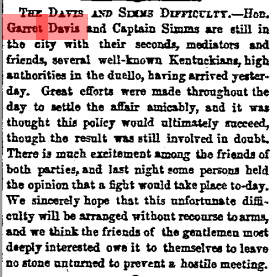
Hon. William E. Simms
William E. Simms was born in Cynthiana, Harrison Co., Kentucky on January 2, 1822. According to
Wikipedia:
Richard H. Hanson
Richard Hanson came from a prominent family of lawyers. He represented the city of Paris and Bourbon County in the legislature from 1846 - 1847 and again from 1863- 1865. He also served in the convention that formed the "present" constitution in 1849. The History of Kentucky by Lewis Collins and Richard H. Collins described his impressive family.
Roger W. Hanson
Roger Hanson was born in Winchester on August 27, 1827. A Mexican War veteran, he participated in the California gold rush before becoming a Kentucky legislator. During the Civil War, Roger became colonel of the 2nd Kentucky Confederate Infantry. Captured at Fort Donelson, he ultimately became a brigadier general and commanded the "Orphan Brigade," Kentucky's most famous Civil War infantry unit. In early January 1863, Hanson was killed in a desperate charge at Murfreesboro, Tennessee.
Sanders, “Clark County's Hanson Brothers,” ExploreKYHistory, accessed July 13, 2014,
http://explorekyhistory.ky.gov/items/show/14
R. W. Woolley
The Leader (Lexington) published this obituary for R.W. Woolley on February 10,1905:
Col. R. W. Woolley died here [Louisville] at 4 o'clock this morning. He was born in Lexington seventy-seven years ago and came of one of the oldest families of the State. He was a nephew of Gen. William Preston and accompanied him to Madrid when the latter was United State Ambassador to Spain. He served on the staff of Gen. Buckner and wrote letter severely criticizing Gen. Bragg for which he was reprimanded by President Jefferson Davis. The news of Col. Woolley's death was not unexpected by relatives here as he has been in failing health for sometime. His wife was Miss Mary Johnston, of Louisville, and died sometime ago. He leaves two daughters, Mrs. Oscar Fenley, of Louisville, and Miss Sophia Johnston Woolley, both of whom were with him.
R. W. Woolley was an accomplished attorney in Louisville, Kentucky and served in a variety of roles that can easily be found by a search of the internet.
The trial of Thomas Probert took place seven years before the beginning of the Civil War. It appears, however, that the prosecutors in this case would side with the Confederacy or were at least southern sympathizers during the Civil War.
Given the popularity of the victim, Jacob K. Spears, I can't imagine how Thomas thought, in light of this team of prosecutors, that there was going to be any kind of positive outcome for him in this trial.