Sunday, November 21, 2010

Irish Landscapes


I just couldn't move on without sharing a few pictures of Ireland.  The landscapes are breathtaking in a pastoral sort of way.  I want so much to return and spend more time around the area of Pallasgreen, viewing what my ancestors viewed.

Pictured above is the town of Doolin in County Clare, close to the Cliffs of Moher. It is famous for its pubs where locals perform authentic Irish music and members of the audience volunteer to recite poetry and sing songs.
These are pictures from the Dingle Peninsula.  It is beautiful partly because it is still pretty much in its natural state.  The road around the Slea Head drive has been improved, but is largely one lane.  There is very little commercial activity other than the tour buses that travel the roads each day.  Since we were there in September, even this traffic was minimal.

I can't possible do justice to the beautiful landscape of Ireland with just a few pictures.  I put together a photoshow with a couple of hundred pictures of Ireland and Scotland.  It is set to Irish music.  I warn you -- it is 23 minutes long.  However, you can stop it at any time. I hope some day that all of my readers have the chance to go to these two countries.  Ireland and Scotland Photoshow

Saturday, November 20, 2010

Nicker Church and Cemetery

Pallasgreen or Pallasgrean (Irish: Pailís Ghréine, meaning "stockade of Grian") is a village in East County Limerick, situated on the Limerick–Tipperary N24 road. The name means "the Stockade of Grian," referring to an ancient Irish Goddess of Love, whose is associated with the a nearby hill of Nicker. Wikipedia


As mentioned in an earlier post, our new friend, Bill, directed us to the Church located on Nicker Hill. The geology of the hill is interesting in itself, and a grotto was dug into the hillside.  After the gothic churches I had become so familiar with in Germany and in the cities of Ireland, I was initially surprised by its overall simplicity.


Near the grotto and to one side of the church yard were the graves of several priests who had served this church.  The church was not open, but we were able to get in the vestibule and see that parts of it were undergoing restoration.  A couple of men working on the landscape told us that the church had a new pastor, and he encouraged them to really work on fixing up the church, its surroundings, and the cemetery located a couple of miles away in Old Pallas.


Right across the street was a field with very pastoral views of the surrounding countryside. It really was very rural.


We followed the directions given to us to find the old cemetery in Old Pallas.  One of the things I found most interesting was that most of what we would call grave markers, appeared to be memorial markers instead.  A marker would be engraved with the names of several family members and often more than one generation.  They would say that they were erected "In Memory Of..." The parishioners told us that until the new pastor arrived, the cemetery had become quite overgrown.


It was clear that the cemetery had originally been placed alongside a church that was now in ruins.


Many of the grave markers were dedicated to Ryans and Dwyers. I got really excited when I saw a grave marker that listed Matthew Ryan, father of Jeremiah.  "Our" Matthew allegedly died in 1855 and I believe he had a son named Jeremiah.  Upon closer examination, I noticed that this Matthew died in 1955.  I'm sure they were all related, as all of the Ryans and Dwyers in the area were "cousins".


                                                                It reads:  Erected by
                                                                JEREMIAH RYAN
                                                                       Ballyludgy
                                                              In memory of his father
                                                               MATTHEW RYAN
                                                             son of DARBY RYAN
                                                               and MARY KELLY

I love old cemeteries -- just ask my sister, Karen, and my niece, Julie.  If you want to see more of the grave markers, click on this link to the Pallasgreen Photoshow.  You can pause on the grave markers and watch them 'til your heart is content.  Pallasgreen, County Limerick

Sunday, November 7, 2010

The Irish Homeland

"Bill" a local, and Kathy, discussing "Ryans" outside of Chasers Pub

Two months ago Bill and I had the opportunity to travel to Ireland and Scotland. One of the items on my bucket list was to visit the town of Pallas Grean (also commonly spelled Pallas Green), the hometown of my Ryan ancestors. Pallas Green (and you should see the Gaelic spelling) is located in County Limerick, right on the border with County Tipperary.

Earlier in this blog (see posts dated March 29th and 30th) I posted pictures of what Pallas Green looked like in 1920 -- right after the Republic of Ireland became separated from Great Britain. Now it is a modern-day town located on a newly-paved main thoroughfare paid for partially with European Union funds. Talk to anyone who went to Ireland 10 years ago and who returned again recently and you will always here about the improved roads. Some are so recent that the GPS we rented did not acknowledge the new roads.

In the United States we describe small towns as places with one traffic light. In Ireland the traffic lights are replaced with "roundabouts". Pallas Green is such a small village that there is not even a roundabout in the town center. However, we counted three pubs at one intersection.


Records indicate that our "Ryan" married a "Dwyer" or O'Dwyer. Interestingly, the pub that is on the opposite corner from Chasers is O'Dwyers.

Here Bill asks for a "second opinion" from another local. Both assured me that if we didn't know the "nickname" of our Ryans, we would not have a very fruitful search. I had to be content with the work completed for me by a County Limerick genealogist. At least Bill could give us directions to the church and cemetery.


I put together a three-minute photoshow that contains these and pictures of the nearby church and cemetery that serves the area of Pallas Green. They are labeled. Click on this link to view: Pallas Green The church and cemetery will be discussed in the next post.

Saturday, November 6, 2010

Cousins in Germany


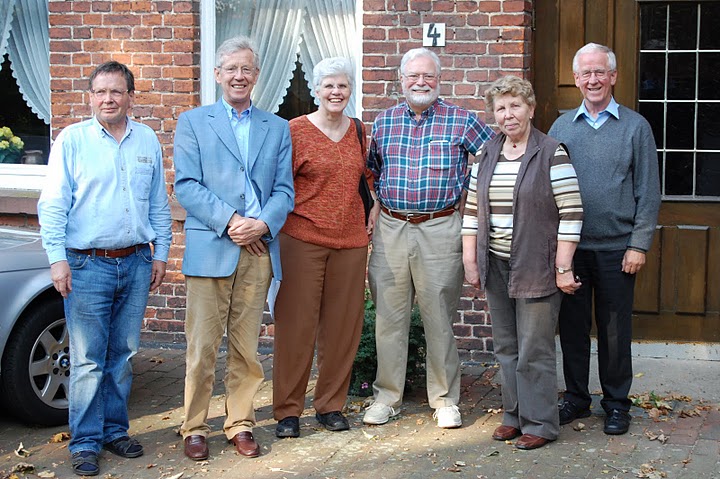
Alois, Heinrich, Kathy, Bill, Mathilde, Hubert

In an earlier post, I told you that our friend and local genealogist, Werner Honkomp. Werner met us where we were staying in Holdorf and took us on a full-day tour of the area. In the afternoon, he had a special surprise. He took us to the home of Alois von der Heide. Alois lived in a home that had once belonged to a von der Heide who married a Borgmann. His brothers Heinrich and Hubert, and his sister, Mathilde also came. Werner suspected that we might be related.

There is no way to describe how much we enjoyed this. We suffered from a bit of a language barrier, relying on Werner to translate. They explained to us that in this region of Germany, even German is a second language. They grew up speaking Plattdeutsch (often referred to as low German). Alois had prepared numerous pictures and documents for us to take with us. The family verified for us that the family plot we had photographed in the cemetery was their family plot. We were given copies of correspondence to their Borgmann family that had relocated to Cincinnati. Upon return I was able to verify that this branch of the family was related to Jim Borgman, editorial cartoonist. In addition, we are (as suspected) distant cousins sharing a ggggg-grandfather.


Alois gave me a picture of the house and identified the people in it. I know the picture is hard to make out, but the picture is the family of Heinrich von der Heide and Joanna Borgmann. Their daughter, Mathilde, is looking out of the window on the left. Son, Heinrich, is on the horse with his brother, Franz, standing nearby.


Alois, Mathilde, Heinrich, Hubert, Werner and me sharing family documents.

Alois shared two additional pictures that had been in his family. We were told that the first picture was of the Borgmann/von der Heide family and I recognize the man in the upper left as Ben Borgmann who came to Cincinnati. The woman to his right is his wife, Catherine Pirron. I think this picture may have been taken in Cincinnati in 1896 and returned to the family in Germany. (Note: This information was updated on 8/28/2018 by Diana Roehm. Diana is Ben and Kate's granddaughter). Ben is holding Catherine Borgmann Sellhorst, his younger sister. His wife is Catherine (Kate) Pirron.  Diana also thinks the man on the top right is August (Gus) Borgmann, brother of Ben. His wife (to the left) was Anna Josephine Janszen. Harry is sitting in front of Gus. The couple in the middle is August Borgmann Sr. and his wife, Bernardine Von Wahlde Borgmann to his right.  Diana thinks that the woman to the left of August Sr. is Frederica (Ric). From left to right, the children in the bottom row are Mary Ann, Frank, and Bernardine.


I am unsure of what occasion is reflected in the next picture. Unfortunately, Alois did not know the names of those pictured. He did, however, circle one face on the back of the picture. It jumped out right away. I don't know who it is, but recognize that "von der Heide" look.


Look at the pictures of five von der Heide men below. Is it just me or do you see similarities in facial structures. Post your answer in the comments section.


By the way -- the identities of the von der Heide men are as follow: Hubert (a Catholic priest), Heinrich (holds a position in Cologne similar to a city councilman), our g-grandfather August, August as a young man, and unknown von der Heide in Germany.

I want to acknowledge Werner, pictured on the left, without whom none of this would have been possible. He has patiently answered my questions and those of many others tracing their genealogy in this region. I will forever be grateful to him.

Friday, November 5, 2010

Earlier Generations


Hermann Henrich "Henry" VDH was born on March 17, 1839 in Holdorf-Ihorst. I've included a map that shows how close the farming communities were in relation to each other. He was the son of Gerhard Henrich VDH and Maria Catharine Ortmann. (It was traditional in that part of Germany to give a child several names. They were typically "known by" the last name in the list. Gerhard Henrich was born in 1802 in Dinklage and Anna Catherine was born in 1802 in Damme. Damme is a few miles southeast of Holdorf and just off the map.

The earliest records I have for the von der Heides has them living in the Dinklage area. Since all of these towns were within a few miles of each other, we visited each of the communities and the churches where they were probably baptized. The church pictured on the left is the one in Dinklage. The one on the right is St. Victor in Damme.


Once again the baptismal records list the family as "Heuerleute" working as hired hands on the farms of others. The book on the history of Holdorf included pictures of farm families in the early 20th Century. This generation worked the farms a century earlier. They generally had large families and just surviving was a full-time job.


Henry's Uncle Hermann, brother of Gerhard Henrich, emigrated to Cincinnati a generation before Henry and Elizabeth came with their young family. His uncle probably paved the way and made the transition easier. My Vonderheide g-grandparents are buried in St. Joseph Cemetery Old -- the German cemetery located on the west side of Cincinnati.


This is the grave marker for Hermann "Henry" Vonderheide, father of August, Joseph and Henry.


This is the grave marker for Catherine Elizabeth Kamphake Vonderheide, mother of August, Joseph and Henry. They were the first Vonderheides in my direct line to come to America.

Cemeteries


When you return to the homeland of your ancestors, you want to try to understand as much as you can about their lives. Ironically, that often means learning as much as you can about their deaths.

Armed with great documentation of my German ancestors I wanted to visit the farms where they lived, the towns where they worked and shopped, the churches that were the center of their lives, and of course, their graveyards.

The Germans have different traditions about burial and graveyards than we do. It wasn't hard to find the "current" cemetery where residents of Holdorf are buried. Yet when we asked Werner where it was likely that my ggg-grandfather was buried, he pointed to the paved terrace surrounding the church. At one point, the graveyard for church members occupied the area just outside the church which had been surrounded by a rock wall. Werner remembered the graveyard being dug up when the church updated its heating and air conditioning systems. The rock wall came down and brick pavers now surround the church. If you look carefully at this wedding picture from 1938, you can see what was the church cemetery beyond the far wall.

In Germany, gravesites are not "permanent." Often they are rented for a period of 20-30 years. In the Holdorf area, many of the plots are family plots. Family members are expected to maintain the site. There is no such thing as "perpetual care." If descendants move away or emigrate, it is not long before the plot is "recycled" for use by another family. The goal of burial is for the body to decompose as quickly as possible and the science of decomposition is studied. There has been some concern lately about "waxy" bodies that have resisted decomposition and the Germans are looking for solutions to this problem. for an interesting article on this issue, click on this link: Waxy Bodies

Even monuments are not permanent. Bill and I spent about an hour in the Neuenkirchen Cemetery looking for a monument that had been placed in honor of his cousin, Fr. Joseph Duerstock. He was the long-time pastor of Old St. Mary Church in Over-the-Rhine. Another genealogist even sent me a picture of this large memorial. It has now been removed.

Going through the Sts. Peter and Paul Cemetery, we saw many family plots with surnames that are common in Cincinnati. These include: Rehling, Borgerding, Wolkerding, Ortmann and Hilgefort. Bill has Hilgeforts in his line. We found that descendants of the von der Heides and Hilgeforts lived in the same farming community in the 1850s.

I started this post with the family part for "Heinrich von der Heide" -- one of our family names. Little did I know when I took the picture that we would later meet the family who owns this plot. Better yet -- we are "cousins"!

Thursday, November 4, 2010

The Role of the Church


One of the things that amazed me was the beauty of the churches. These were rather small communities and I could not believe the architecture and intricacy of the altar pieces and stained glass windows. As it ended up, much of the land was owned by the Church. The peasants were landless and farmed the land, paying rent to the Church. This guaranteed a steady source of income.


In present day Germany,churches are supported by a "Church Tax." The following explanation was found on wikipedia:

About 70% of church revenues come from church tax. This is about €8.5 billion (in 2002).

Article 137 of the Weimar Constitution of 1919 and article 140 of the German Basic Law of 1949 are the legal basis for this practice.

In Germany, on the basis of tax regulations passed by the communities and within the limits set by state laws, communities may either

  • require the taxation authorities of the state to collect the fees from the members on the basis of income tax assessment (then, the authorities withhold a collection fee), or
  • choose to collect the church tax themselves.

You can follow the links for a more comprehensive explanation.

Werner told us that many in Germany choose not to be a part of a church to avoid paying the tax. However, if you do not belong to a church, you may not get married, buried or participate in other religious functions of the church. You pay or you don't play.

The original Sts. Peter and Paul Church was constructed in 1827. Previously, residents of Holdorf attended church in the nearby town of Damme. The original church was very simple by comparison to the new one. The nearby town of Steinfeld applied for a grant and was able to tear down and rebuild the church for a multi-purpose use. One floor of the former church is a tannery museum. After the new church was built, there was a period of time when the building was used as a tannery. The second floor houses local records, a meeting room and is part of the Historical Society. Werner's nephew is mayor of the town and took us on a tour of the building.

Interestingly, the original doors of the church were recovered and are now on display on the second floor. They had served as doors to a tavern for many years.


I was so happy to see the baptismal font so prominently situated in Sts. Peter and Paul Church. I have every reason to believe that my g-grandfather, August, and his siblings were baptized at that very font.

Past vs Present - Part II

When I see pictures of unpaved roads and what 21st Century Germans and Americans would consider to be rather primitive housing conditions, I have to remind myself that many of the same conditions existed here 150 years ago. It wasn't all that long ago, that transportation was by horse and carriage (if you were among the lucky) and indoor plumbing was uncommon -- especially in rural areas. Coming to America could, in some cases, mean exchanging one set of undesirable conditions for another. Add into the mix a new language, hostility toward new immigrant groups, a country recovering from deep divides between north and south and I find myself in awe of my ancestors.

When Bill and I went to Germany, we were fortunate to be introduced by Werner Honkomp to the Mayor of Holdorf, Bernard Echtermann. He gave us a copy of a book, written in German of course, that chronicled the history of the region. These pictures give you a better feel for the area in the early 1900s.


This is a picture of Holdorf's Main Street. Note the church steeple on the right. This is the steeple of St. Peter and Paul's Church. The street is now much wider, the trees are no longer there, and the street is paved. The first picture below on the left shows the buildings that replaced the two on the left side of the street that burned down. The picture on the right shows the current street scape leading up to St. Peter and Paul Church.


Very close to Holdorf is a farming community called Fladderlohausen. Pictured in the book was a Heuerhaus from that community.


Another picture from the book shows a shoemaker making and wearing wooden shoes. Unfortunately, the picture is a little overexposed, but if you look carefully you can see the shoes. Holdorf is not far from the Netherlands and wooden shoes were part of the common attire. We were told that on Sunday mornings it could get quite noisy in the Church as parishioner after parishioner "clopped" their way to their pew.

Past vs. Present - Part I

One of the things that was most surprising to us was how the Heuerleute (non-landowning workers) live. Often they lived in what was called the Heuerhaus. This was often not much more than a barn that housed the farm animals as well as one or two families of workers. We were able to see one of the two Heuerhauses of the Lampe-Gossling farm. The one that is pictured with a red arrow, points out the location of the "haus" that had burned down and been replaced by a modern building. The black and white pictures were taken in 1930, fifty years after the Vonderheides emigrated.

We were able to see first-hand the surviving Heuerhaus, just down the street from the center of town and the Church. I am pictured with Werner and Mayor Bernard Echtermann who graciously toured the town with us.


Werner explained to us that each completed building included a carving by the main builder/architect. If you notice, you can see that this building was constructed in 1822.


We opened the door to the building and viewed what had been stalls for the farm animals. The farm owner lives in a thoroughly modern home and this building now functions as an outbuilding. I'm sure 150 years ago, the floor was not concrete.


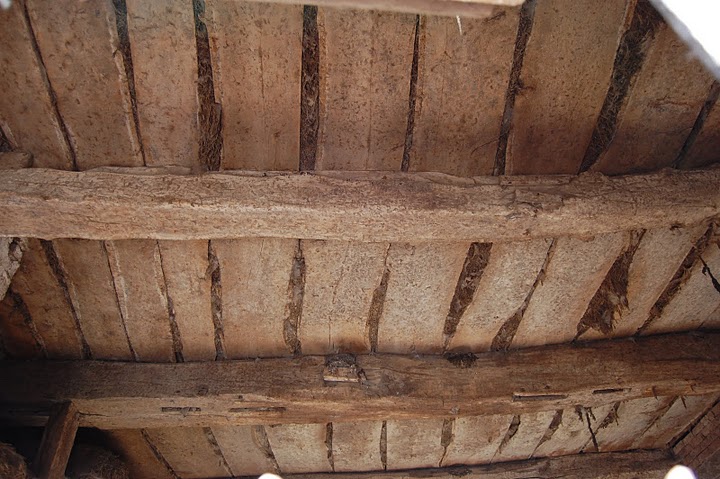
The original hand-hewn beams are visible and a tribute to the architecture of the time.


Not far from Holdorf in Cloppenburg (about 30 miles) an outdoor museum is located where many of the buildings from that era have been moved and preserved. It includes windmills, carriages, farm equipment, and living spaces so that visitors can visualize just how people of the time lived. I was especially interested in the kitchen area. Pictured below is one example of a kitchen built at one end of a Heuerhaus. Fire was a constant threat.


One common site throughout this area of Germany was a shrine with a crucifix as if the farmers were asking God's blessing upon their farms and homes. The Lampe-Gossling Farm was no exception. Here is their shrine, just outside the current family home.


Note: The black and white pictures on this post and several that follow are taken from a book on the history of Holdorf called Die Gemeinde Holdorf im Wandel der Zeit, ISBN: 978-3-86595-162-5 http://www.geigerverlag.de