Showing posts with label Great White Fleet. Show all posts

Friday, February 4, 2011

James N. Ryan - Great White Fleet - Welcome Home!

Political cartoon from The New York Herald, February 22, 1909. Illustration shows Uncle Sam, George Washington, and Theodore Roosevelt welcoming the Great White Fleet as it returns to home port at Hampton Roads, Virginia.

Credit:  Wikipedia - The Great White Fleet


On Washington's Birthday, February 22, 1909, the Great White Fleet returned home after its 14-month adventure.  I can't even imagine the emotions of all involved.  In hindsight, I'm really glad that "our" Jim was able to take part.  He was able to cram a lifetime of experiences into what would turn out to be a very short life.

We do not have much information on Jim's naval career after returning home.  One postcard reflects what was probably pretty typical -- time spent with the ship in dry dock undergoing repairs and upgrades. This card was mailed April 7, 1910 from the USS Virginia, six weeks after their return.


We are now at the Southern Drill (?) Grounds.  Will be here for three weeks.  Love to all from your son, Jim.

On July 1st, 1910 Jim was promoted to Fireman, 1st Class.  This was followed a month later to a promotion to "Acting Appointment to Blacksmith (Foundryman)."  According to his service record, nothing noteworthy happened until Jim stayed overleave from 4:00 PM October 6th to6:00 AM October 8th.  For this offense, he was tried by a "Deck Court" and fined $16.50 pay.  

His ratings suffered for that three-month period.  The rating for "Obedience" dropped to 1.5 on a five-point scale and in the column indicating whether or not he would be recommended for Honorable Discharge said "No".  The "5" was a rating for "sobriety."  Jim consistently rated well in this category.  The disciplinary procedures must have had their desired effect because Jim's service record remained complaint-free for the rest of his career.


But tragedy was just around the corner . . .

Thursday, February 3, 2011

James N. Ryan - Great White Fleet - The Final Leg

http://www.greatwhitefleet.info
During the final leg of the cruise, the USS Virginia departed from Manila, traveled through the Suez Canal, and made stops in Smyrna, Turkey and Gibraltar before heading home to Hampton Roads, Virginia.  Each member of the USS Virginia was issued a commemorative chart of the entire cruise.  Matt Biederman has Jim's copy framed and in his home.  You can click on the link under the chart above and scroll around the entire map.  You can see where the battleship was on each day and the number of nautical miles sailed while at sea.

Credit:  http://www.greatwhitefleet.info
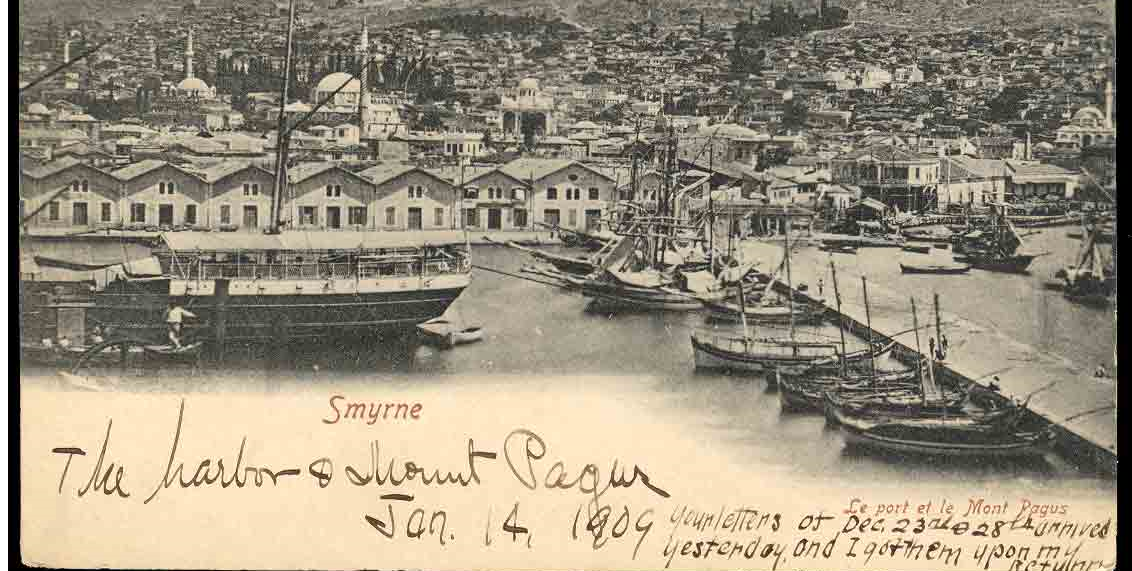
In the Mediterranean, different battleships docked at different ports.  The Virginia stopped in Smyrna, Turkey. This was a place of special fascination for Jim.  Matt has a letter mailed home from Turkey.  I love its contents.


Here is my best attempt at a transcription:
Smyrne, Turkey
January 13, '09
Dear Father,
Your loving letter of December 25th was received yesterday and I was more than delighted to hear from you. We arrived here in Smyrne on the 11th and we stay here until the 25thh of January. It is very cool in this part. You know we are not very struck on cold weather, not being in a cold country on a long while. I think we'll know it alright when we strike New York. The ships company of this ship is kept very busy at this point.  We are going through a navy yard overhauling. I think the ships will have to stand a very strong inspection when we get back to New York, so we are trying to make the ship look it's best.

Well, dear Father, how are you and dear Mother and why don't she write?  It is a coon (?) age since I heard from her.  What is a matter with Rose also, why they must be afraid to write.  I wish you would get them to write me a letter now and then.  Also give them my best love.

I see by your last letter that Mrs. Luffuss ? out to the house.  I also see that she made a hit.  Well what do you think of her?  Would you leave your happy house for her ?  I guess she thinks I am a peach.  I have not sent her a postal or anything since I have been on this trip.  But what is the difference is you got a good pull.  There is another lad on this ship who is writing to her. He kept company with her before he shipped in the navy.  He is a duckman, too.  But she don't know that I know him.  But I do.  So you see I am a good heart.  I am giving him a chance to make good.  So if he don't, it is his own fault.

Say how ? to Eddy to give him my best.  Tell him it will hurt him to drop a note now and then.  I was ashore the day before yesterday.  I think this is the most immoral place I was ever in.  Turkish you know you can get anything you are looking for.   Well, dear Father, as I have wrote all I really know I will have to bring my letter to a close.  Hoping to hear from you very soon. I remain, as ever, your loving son.

James N. Ryan

James N. Ryan - Great White Fleet - San Francisco to Manila

USS Virginia Postcard by Enrique Muller 1907  Credit:  http://www.greatwhitefleet.info


On the third leg of the tour, the USS Virginia, as part of the second squadron, departed San Francisco on July7, 1908. The first port of call was Honolulu, Hawaii. At the time Hawaii was a U.S. Territory.  It would not become a state for fifty more years.  I can't imagine how different Hawaii would have been 100 years ago.

Credit:  Wikipedia - The Great White Fleet

Credit:  http://www.greatwhitefleet.info
Fortunately for us there was an electrician, Frank Lesher, aboard the USS Virginia who collected items from each port.  He kept medals, programs of activities set up for the sailors, letters, and numerous picture postcards. An example from his collection is pictured at the left.  It is a picture of the former queen of Hawaii.

As the focus of this blog is on family history, I'm going to refer interested readers to a website that includes extensive information on each port of call.  You can read his personal correspondence back "home" and get a feel for the kinds of experiences Jim might have had.
Go to: Hawaii  I can't urge you enough to check out this site.  You can choose from among a list of ports and view some of Frank's collection.

One of the most important ports of call was Yokohama, Japan.  The family is in possession of a beautiful embroidered work that Jim acquired in Japan.  Closeups of this work were featured in a previous post.  Pictured is a ticket issued to the sailors for free train transportation.

Credit:  http://www.greatwhitefleet.info


The fleet headed to Manila in the Philippines where they were again greeted warmly by the local population. Who could have anticipated what would happen in this area of the world a short 32 years later.

Wednesday, February 2, 2011

James N. Ryan - The Life of a "Coal Passer"

Jim Ryan (standing on right)
The Department of the Navy has a website on the "Cruise of the Great White Fleet." I was surprised that the site included a great description of the role of a "coal passer."
The good times were earned by these sailors. There was the seemingly endless round of cleaning chores, watches and drills. But even for the hard-working deck force, life at sea wasn't quite so bad, not when compared to the jobs of the so-called "black gang" in the fire room below decks. At least topside, the deck force had the benefit of sunlight and breezes; below decks, the engineers' world was dominated by searing heat and coal dust.
Coal, commonly referred as "black diamonds," was the ship's sole source of power. Ships would normally go into port and take on coal every two weeks. "Coaling ship" was an all hands evolution and a dirty job. It would take several days to coal a ship. Afterward, the crew would spend several more days cleaning the ship, inside and out, fore and aft, since coal dust settled everywhere.


 Members of the "Black Gang", stoke the coal burning power plants of the Battleships of the Great White Fleet. C. 1907-1908. NH 101721.
Members of the "Black Gang", stoke the coal burning power plants of the Battleships of the Great White Fleet. C. 1907-1908. NH 101721.
A member of the "black gang" on the battleship Connecticut described coaling day. "Our ship held about 2,000 tons of the stuff. All the deckhands would go down into the collier (coal supply ship) and fill these big bags with about 500 pounds. Then they'd hoist 'em over to us down in the coal bunkers and we'd spread out the coal with shovels until all the bunkers - about 20 - were full to the top."
The Navy published a booklet called "The Making of a Man o' Warsman."  (Note cover in previous post). Each day 2 1/2 hours was devoted to practicing drills.  Drills might include signaling, collision avoidance, fire prevention, etc.  On p. 14, there is a description of the Coaling Drill.
Coaling Ship.--The most arduous work the men must perform on board a man-o -war is coaling ship. Strictly speaking, "coaling ship" is not a drill, but for convenience in explaining this work we will call it so. Lighters filled with coal are brought alongside and the men are stationed in them to fill bags, and also stationed aboard ship to receive and send the bags below, the bags being carried from barge to ship by means of electric hoists. The men of the engineer's force stow the coal in the bunkers. Signals are hoisted each hour on each ship of the fleet to show the amount of coal taken, which causes keen rivalry among the ships. Coaling is not a thing of great frequency. It may take place once a month, or once in three months, depending upon the amount of cruising the ship is doing.
This is how Jim initially made his living.  When he enlisted as an apprentice seaman, he was paid $17.60.  On January 1, 1910, Jim was promoted to Fireman, 2nd Class.  This promotion put him on a new career path with a corresponding increase in pay.  According to the manual cited above:

FIREMEN
The fire-room force on board a man-of-war consists of chief water tenders, at $55 and $77 a month; water tenders, $44; oilers, $40.70; firemen, first-class, $38.50; firemen, second-class, $33; and coal passers, $24.20. After serving one enlistment (4 years) in any of these capacities a man may take a course at the Machinists' School, in Norfolk, as previously stated, and, if he graduates, may enter the machinists' branch, and is eligible to the promotion of a machinist's mate as explained in the previous chapter. p. 18
This promotion took place about two weeks after the fleet left on its round-the-world tour.  Two more promotions would follow.  Life had to be looking up.  In the next post, we'll discuss the third leg of the tour.

James N. Ryan and the "Great White Fleet"

I have to admit -- I'd never heard of the "Great White Fleet."  Along with the artifacts that Matt Biederman shared with me by email, he included a link to a site that discusses the Great White Fleet. Jim may have died at the age of 22, but what a life he had!


According to the Wikipedia site,
The Great White Fleet was the popular nickname for the United States Navy battle fleet that completed a circumnavigation of the globe from 16 December 1907 to 22 February 1909 by order of U.S. President Theodore Roosevelt. It consisted of 16 battleships divided into two squadrons, along with various escorts. Roosevelt sought to demonstrate growing American military power and blue-water navy capability.

President Roosevelt envisioned the tour to be a demonstration of not only U.S. seapower, but also American industrial prowess.  The fourteen month-long voyage included sixteen battleships with hulls painted in peacetime white, hence, the nickname.  The squadrons were manned by 14,000 sailors.  During the tour, the fleet traveled 43,000 nautical miles, making twenty port calls on six continents.  What an adventure for a 18-year old!

Credit:  http://www.greatwhitefleet.info/

Jim began his naval career as a "coal passer." He and his colleagues were responsible for the "fuel" that powered these ships. If you refer to the previous post, you can see that the picture showed Jim and crew members aboard a "Coaling Ship." Jim was initially assigned to the USS Franklin but was transferred to the USS Virginia in the October before the fleet's December departure. Over the next fourteen months, this boy from Elmwood Place was about to become a man.

The Great White Fleet

The tour was divided into four legs. Since the Panama Canal was not yet completed, the fleet had to travel around the South American continent.

Credit:  Wikipedia - The Great White Fleet

On the second leg, the fleet traveled from San Francisco to Puget Sound and back. Our young man, Jim, must have loved San Francisco. His disciplinary report states that on June 23, 1908, he returned three hours overleave to the Virginia. Apparently, the ship was in port preparing for the third leg of the trip that would take them to the Philippines.  I can't imagine the joy of traveling the world at such a young age.  In the next post, I will discuss the life of a "coal passer"/ fireman aboard ship.