Showing posts with label Hon. Garrett Davis. Show all posts

Tuesday, February 3, 2015

Who Was Col. Speed Fry?

Since I first discovered the children of Kate and Thomas Probert, I couldn't help but wonder why they would name their son Col. Speed Fry. I don't know why it didn't occur to me to "google" that name until today. I should have done it a whole lot sooner because it explained a lot.

Recall that Col. Speed Fry Probert was born on February 14, 1862 -- just as the Civil War was gearing up. He was named after Col. Speed Smith Fry who served on the Union side of the Civil War. For those of you who may not be aware, most of Kentucky was pro-union at the beginning of the Civil War and pro-Confederate by the end. Although the issue of slavery became one of the main issues by the end of the war, it hadn't started out that way.

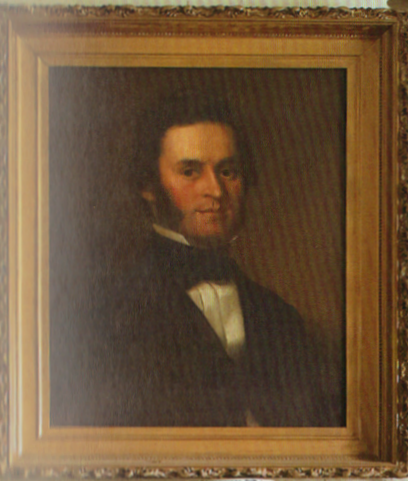
You may recall that a member of Thomas Probert's defense team, Garrett Davis, was a pro-Union man who was totally against secession. By the end of the war, this owner of 15 slaves had become completely disillusioned with the war and later ran for the Senate as a Democrat -- not the party of Lincoln.

Credit: Wikipedia

Such was not the case with Col. Speed Smith Fry. Col. Speed Fry was responsible for raising the 4th Kentucky Infantry. He played a major role in the Battle of Mill Springs which ended up being the first major Union victory of the war. The battle took place on January 19, 1862 -- about four weeks before the birth of Thomas and Kate's son. Col. Speed Fry was given credit for killing the Confederate General during some confusion. Apparently, General Zollicoffer mistakenly thought Col. Speed Fry was a Confederate. He rode right up to the Col. and accused him of shooting at fellow Confederates. By the time this mistake was recognized, the General had been fired upon and killed instantly. There is a lot of information available, often not consistent, about the details of this battle. But one thing was clear -- it was a victory for the North.


Credit: www.millsprings.net
I can only imagine that this victory was important to the Proberts as they thought the colonel would be an appropriate namesake. In addition, this research leads me to conclude that the Proberts, at least initially, favored the Union position.

Things were definitely getting off to a rough start in Mt. Sterling. It had to get better.

Tuesday, August 5, 2014

How to "Preserve Your Honor" by Having a Duel

Over the past few months, I have read a lot about the "tradition" of challenging someone who has "insulted" you by challenging them to a duel. It was considered to be part of the "honor code." If a "challenge" was offered, you had to respond or your "manhood" would take a hit. If you are as curious as I was about this topic, you can read some of the rules for dueling. If you understand the "honor code" of the time, you have a better idea of why Jacob Spears felt he had to defend his honor with a duel after Thomas Probert told him "not to show his backside."

Jacob Spears
The last two posts discussed the powerful men who served on the prosecution and defense teams for the trial of Thomas Probert. The whole tragedy of the death of Jacob Spears was the result of what Jacob perceived as an "insult" and the need to "defend his honor." Imagine my surprise when further research showed that five years after the trial, two attorneys involved in the trial were about to have a duel of their own!


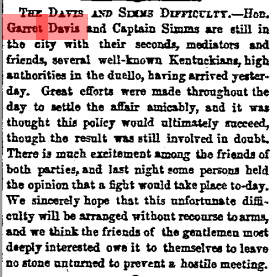
The Honorable William E. Simms (Prosecution) challenged the Honorable Garrett Davis (Defense) to a duel over comments made by Davis and reported in a newspaper article published in the Paris Citizen. According to an article in The Cincinnati Enquirer published on June 14, 1859, the "challenge" resulted from this incident:
The Cincinnati Enquirer, June 4, 1859, p. 2.


You can read a rather lengthy exchange of letters that were published on June 17, 1859 in the Louisville Courier. The article  discussed a "Difficulty Between Capt. Wm. E. Simms and the Honorable Garrett Daivs. What's fascinating to me is that, in an effort not to break the law in Kentucky, they both agreed to hold the duel in Cincinnati.

The Cincinnati Enquirer, June 21, 1859, p. 4.

Luckily for all concerned, cooler heads eventually prevailed. With the mediation of several "friends" and representatives of the two men, the complaint was eventually withdrawn. The Louisville Daily Courier published the following resolution to the "difficulty" in its June 23, 1859 edition:


Ironically, Garrett Davis later signed legislation forbidding duels as a means of resolving differences in Kentucky. Even today when the Governor of Kentucky is sworn in, part of the oath requires that he/she swear that they have not and never will participate in a duel. "The times they are a'changin'." Bob Dylan

Monday, August 4, 2014

The Defense Team

I had the pleasure of speaking to someone who is in the extended family of Jacob Spears, the person shot in this case. She still lives in the area and knew quite a bit about the members of both the Prosecution and the Defense Team. She made the observation that there must have been quite a bit of sympathy for Thomas' actions as he was well-represented by power houses of the time.

Garrett Davis


Garrett Davis (September 10, 1801 – September 22, 1872) was a U.S. Senator and Representative from Kentucky. Garrett Davis was born in Mt. Sterling, Kentucky.After completing preparatory studies, Davis was employed in the office of the county clerk of Montgomery County, Kentucky, and afterward of Bourbon County, Kentucky. He studied law and was admitted to the bar in 1823, where he commenced practice in Paris, Kentucky.
Davis served in the Kentucky House of Representatives from 1833 to 1835. Afterward, he was elected as a Whig to the United States House of Representatives, serving from March 4, 1839, to March 3, 1847. There he was chairman of the Committee on Territories. Davis declined to be a candidate for reelection in 1846, but instead resumed the practice of law and also engaged in agricultural pursuits. He refused to reenter politics the next fifteen years. Davis declined the nomination for Lieutenant Governor of Kentucky in 1848, and declined the American Party nomination for Governor in 1855 and for the presidency in 1856. (Note:  This was the year that he served as part of the Defense Team for T.H. Probert).
Davis was opposed to secession, however, and supported the Constitutional Union Party ticket in 1860. This convinced him to reenter politics, and he was elected by a Unionist Party position in 1861 to the United States Senate to fill the vacancy caused by the expulsion of John C. Breckinridge. He was reelected as a Democrat in 1867 and served from December 10, 1861, until his death in Paris, Kentucky, in 1872. He served as chairman of the Committee on Private Land Claims. He was interred in Paris Cemetery. By the end of the Civil War, he like many Kentuckians, was totally disillusioned with the North. (Wikipedia)
William Wilson Alexander
Birth: March 2, 1819
Death: July 21, 1874 Age: 55

William Wilson Alexander Son of William and Jane (Stamps) Alexander. Born March 2, 1819, in Paris, KY. Prepared for college at Paris Academy. On leaving college he entered the law department of Transylvania University, and took his degree of LL.B. and established himself at Paris. His practice extended to the adjoining counties. He was County Attorney of Bourbon county for a number of years, and served two terms in the Legislature. Married in Wilkinson county, MS, February 27, 1845, to Miss Jane D. Stamps, a native of that county. He died July 21, 1874, leaving a widow and six children. Mr. Alexander was a man of marked ability. An acquaintance says: "As an advocate before a jury, or a speaker before a popular audience, he was captivating and effective. Graceful in gesture, exuberant in fancy, strong in argument, and humane and pathetic as occasion demanded, he seldom failed to touch a chord in the breasts of his hearers, which responded favorably to his appeals." (Certainly to Thomas' advantage).
http://www.frontierfolk.net

Col. T.T. Martin

Despite my best efforts, I was unable to find out anything about Col. T.T. Martin, the third member of the defense team. Given his title of Colonel, however, I assume he was a man who possessed leadership qualities and military experience. Still, the prosecution team outnumbered the defense team by almost 2:1. So what was to become of Thomas?

Tuesday, July 8, 2014

T. H. Probert vs. Jacob Spears, Esq.

Note: If you are arriving at this post with no background on the "killing", you may want to read these earlier posts on this topic:


Over the years, I've searched for every possible explanation for what caused T.H. Probert to shoot Jacob Spears in Paris, Kentucky in 1856. On April 29, 1856, the Louisville Daily Courier published this lengthy explanation. It is the best summary I have found:

The Killing of J. H. Spears at Paris

We saw a gentleman yesterday who was in Paris during the preliminary trial of Thos. H. Probert, for killing J. H. Spears, and, as we and others have published partial accounts of the affair, we will deem it but proper to give the important testimony. On Sunday, eight days before the occurrence, Probert rode up to a fishing frolic and Spears frightened his horse. Probert told him not to show his backside. Spears followed him up and asked why he spoke to him so. Probert said his horse was wild, and, as he was unwell, he didn't wish to be thrown, and he meant what he said. Spears said he was a better man than Probert and could whip him, and insisted on a fist fight. Probert declined, saying he didn't want to mar the enjoyment of the party and would rather postpone it. Spears afterwards told witnesses that he had sent a man to prepare arms; that he intended to call upon Probert, and if anything occurred, murder him. Probert was informed of this, and advised by witness to absent himself from his house, that Spears was intoxicated and might carry his threat into execution. That night Spears visited Probert and was told he was absent. On Friday, Probert went to Cincinnati and returned Monday evening. That evening (Monday) Spears, accompanied by a friend, went as far down the railroad as Cynthiana. Probert was informed by Spears' friends that he got into the baggage car at Cynthiana, and advised to go'in and make up their difficulty, but he didn't wish to see him, and arriving at the depot, at Paris, immediately repaired to his bar-room. (Probert had been the baker for the hotel and had acted as bar keeper for two or three months) soon after Spears friend went down to the saloon of the Bourbon House. His friend remarked to Probert, "I have brought you a customer," and Spears called for something to drink. Probert set out the liquor, and Spears asked him to drink with them several times. Probert declined. Spears asked him if it was because of their difficulty, or if he didn't wish to drink. He said it was the latter. Spears then threw his liquor in Probert's face. Probert asked him if he knew what he was doing. Spears said that he did, and at the same time Probert picked up the pistol, and Spears drew back the glass, and the pistol fired, and the glass was thrown at the same moment. 

Spears received one ball in the neck, one in the face, and one in the side of the head, and two struck the ceiling. The tumbler knocked down a cigar box, and broke a pane of glass in the window. The only person present was Spear's friend and the two young Messrs. Thurston and the landlords of the hotel. Spears lived in a state of insensibility for three hours. The pistol was an Allen's revolver, and it had lain in the same place from which Probert drew it when he fired, behind the water tank, during his absence to Cincinnati.

Spears was proven to have been very drunk in going from the cars, and walked between two friends, who braced him by the arms to prevent his staggering or falling. But Mr. Thurston said he walked alone when in the saloon. Spears was not armed, but his friend ran out of the room when the fight commenced, and said they were both shooting and one or the other must be killed. Probert was not on good terms with Spear's friend. Probert came out and desired to go to jail, and his friends escorted him until the Sheriff could arrive to prevent Spear's friends from mobbing him, who seemed to be afraid he might leave.

The Trial

There was a very large crowd in attendance upon the trial, which lasted from Wednesday until Friday evening, the case being continued each night until 11 or 12 o'clock. The lawyers for the presentation were Hon. Richard Hawes, R.W. Woolley, Richard H. and Roger W. Hanson, and Capt. W.E. Simms; for the defense, Hon. Garrett Davis, Col. T.T. Martin, and W.W. Alexander. The judge committed him for further trial on Thursday, but the question of bail was argued by Davis, Alexander, Woolley and Simms until the next evening. Judge Samuel refused to allow him bail.

The case was conducted with great power and force. The speeches were very eloquent and able, and that of Capt. Simms was particularly moving. His voice faltered and he shed tears in its delivery. He described the deceased as his most particular associate and best friend -- one who he deemed incapable of any but the noblest of actions -- cut down in the prime of life when health, happiness, etc. were before him. The favorite and eldest son of an old man, who leant upon him for support, and his widowed sister's idol. 

Mr. Spears was a single man about 30 years of age, of fine manly form and address, was at one time a resident of Louisville, and had spent much of his time in Louisiana, Mississippi, and the Eastern cities and agent of the large mercantile and manufacturing house of his father in Paris, and, by his genial manners, drew around him a host of young associates who will deeply sympathize with his large and influential relations in Bourbon, at his sad and untimely fate. The Citizen says he was buried by the Odd Fellows and followed to the grave in an immense concourse.