Showing posts with label Robert Willis Darby. Show all posts

Sunday, March 6, 2011

Robert Willis Darby

Photo Credit:  Wikipedia
Robert Darby was the first member of the Darby family to be born in the United States. He was born in Cincinnati on April 17, 1842.  What I know of Robert's life comes by way of Edwin Cyrus Darby's family history:
Father's brother, Robert, married Mary Pacey, an English girl.  Had five sons and four daughters. The boys' names: Jonathan, William, Harry, Arthur. I forget the other boy's name.  The girls: Elizabeth, Bettie, Nellie, Zylpha.  Jonathan married and went to South Carolina.  Had a family.  Willis went to California, married there and died young. If they had any children, I don't know it.  Harry married and lives in Avondale where he was born. Arthur, I believe, went to Massachusetts to live.  Married and had a family.  I don't know anything about Uncle Robert and Aunt Mary.  Both died. She went first a good while ago.  So ends that chapter.
So Edwin left some holes in the story -- holes I've not yet filled. I do know, that like his father before him, Robert was a painter. His death certificate refers to him as a "contracting painter." I know that not only was the family involved in the painting of houses, but also used their talents as sign painters. Robert's wife, Mary, died in 1910 at the age of 65. Robert lived with two of his daughters who remained unmarried.

Near the end of the Civil War, Robert signed up with his brother, Joseph, enlisting in the 191st Ohio Volunteer Infantry on March 8, 1865. (They were previously part of the 185th OVI, enlisting February 13th).  Robert was 22.  The 191st was first ordered to Winchester, Virginia where Major-General Hancock was organizing the First Army Corps. At Harper's Ferry, the regiment was stopped and ordered to report to General John R. Brooke. They were assigned to the Second Brigade, Second Division, Army of the Shenandoah. Their only duty was garrison duty in the valley until they were mustered out on August 27, 1865 in Winchester.  The war was all but over when Lee surrendered on April 9th.

USS Carondolet
For some reason during that period, Robert must have volunteered to become part of the Navy. He became a Corporal and became a member of the crew of the USS Carondolet.  I have not been able to find the date of his transfer to the navy, but I doubt that he saw much action by the time he got there.  This ironclad boat along with similar Confederate boats had played a major role in the war along the Mississippi River.  Here is a picture of the Carondolet in a battle in 1862.

Bombardment and Capture of Island Number Ten on the Mississippi River, April 7, 1862
Colored lithograph published by Currier & Ives, New York, circa 1862.

He served enough time, however, to have it mentioned in his obituary.

OBITUARY: (no date on clipping) CIVIL WAR VETERAN DIES - R.W. Darby was in River Fighting at Close of Conflict. Robert W. Darby, 81 years old, 726 Whittier Street, last surviving member of the crew of the United States steamer Carondelet, active at the close of the Civil War, died at his home late Saturday. He had been ill several months. At the beginning of the Civil War, Mr. Darby enlisted with the One Hundred and Ninety -- first Ohio Regiment and later became a member of the crew of the Carondelet, operating on the Mississippi River. He was a member of the Grand Army of the Republic, Naval Veterans and Knights of Pythias. Surviving him are five daughters and three sons. Mr. Darby was born in Cincinnati.

Both the G.A.R. and Naval Veterans will conduct services at the funeral which will take place tomorrow afternoon at 2 o'clock.

Robert W. Darby (1842-1922)
Robert, along with several members of his family, is buried in the Pleasant Ridge Presbyterian Church Cemetery.  As I've mentioned before, this blog often serves as "cousin bait."  Perhaps one of Robert's descendants will be researching their ancestor and be referred to this post.  Should I hear from one of them, I will update what we know about our Darby ancestors.  

Again I must recognize the contribution of Martha Darby Rutter, who forwarded a copy of Robert's obituary to me and her g-grandfather's Darby Family History.
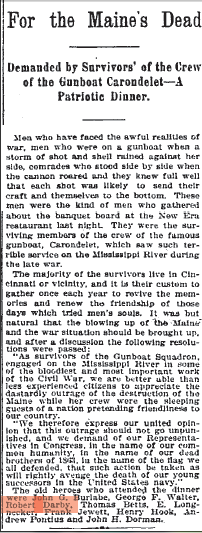
Update:  I recently discovered through newspaper articles from the Cincinnati Enquirer that Robert Darby had apparently participated in one of the most significant battles of the Civil War near Vicksburg on the Carondolet. The top part of the article pictured was entitled "Vengeance for the Maine's Dead."  It appeared in the Cincinnati Enquirer. April 17, 1898, p. 29.


Thursday, March 3, 2011

Putting My Darby Ancestors in Context

Photo Credit:  Wikipedia - Cincinnati in 1841
As mentioned in the previous post, the Darbys emigrated from England to America in 1841. As a life-long Cincinnatian, I was shocked when I saw this picture.  In 1841, the Miami-Erie Canal was completed.  What shocked me was the realization that the canal basically made an island out of the central core of the city.  Cincinnati is a basin city surrounded by beautiful hillsides.  For half a century, almost the entire population lived in the city basin, reinforced by the hillsides and the canal.

Wikipedia describes Cincinnati in the 1840s this way:
By 1840, Cincinnati had grown from a frontier settlement to the 6th largest city in the USA. It was a city of contrasts, with prosperous neighborhoods and squalid, violent slums. Many of the businessmen who controlled the city were interested in good relationships with the slave-owning states to the south of the Ohio River, and were hostile to abolitionists and blacks. The Ohio constitution denied blacks the franchise, and the Black Laws imposed further restrictions. Black children were denied education in the public schools, although black property holders had to pay taxes to support these schools. Black immigrants to the state had to register and provide surety. A black could not serve on a jury, testify in legal cases involving a white person or serve in the militia. However, drawn by the economic opportunities, the black population had grown from 690 in 1826 to an official count of 2,240 out of a total of 44,000 citizens by 1840. Many of the blacks had jobs as craftsmen or tradesmen, earning good wages for the time. Many owned property.
With the city's rapidly-expanding and ethnically-diverse population, trouble just needed a spark.  It came in the form of an extreme drought that resulted in the lowest water level ever recorded for the Ohio River.  The low water level threw many immigrants who depended on the river for their livelihood out of work.  Over a period of several days, several white people (largely Irish) attacked the black population.  For a fuller discussion of what occurred, click on this link.

Jonathan Darby
So here was the "Promised Land" the Darbys, Bickerdykes, and Sidebottoms encountered. This Queen City of the West was just getting started.  This period was just before the large German immigration that was to take place after 1848 as well as a large Irish influx that was to take place during the Potato Famine -- each group fighting for its place at the table.

I've included a Pedigree Chart so my family and readers can better understand my relationship to the Darbys and the generation that chose to serve in the Civil War. In addition to Mary Elizabeth Darby's husband Britton, and her brother, Joseph, brother Robert Darby also served. His story has a bit of a twist. He will be discussed in the next post.


Photo Credit for Jonathan Darby:  Martha Darby Rutter

Monday, February 28, 2011

My Family in the Civil War

Civil War Canon - James A. Ramage Civil War Museum

Photo Credit: Wikipedia
The Civil War or the War of the Rebellion began 150 years ago on April 11th, 1861 with the Battle at Ft. Sumter.  When it was over, there were approximately 620,000 casualties from death and disease.

I had always known that I had a gg-grandfather, Britton Wainright, who died of heat stroke when he was marching to meet John Hunt Morgan of Morgan's Raiders fame. I was able to get extensive documentation of the impact his death had on his family. You can read about him in this previous post.

What I didn't realize at the time was that I actually had four direct ancestors and two siblings of ancestors who served in the war -- all on the Union side. It also seemed to be a family affair. In the case of Britton Wainright, two brother-in-laws also served: Joseph Bickerdyke Darby and Robert Willis Darby. Britton's wife was Mary Elizabeth Darby. These three family members are from my paternal side.

On my maternal side, there were three additional soldiers: my gg-grandfather Charles C. Gross, his brother-in-law, Victor Becker, and Fred Wocher (from a separate branch). Fred Wocher and Victor Becker interest me because Fred lived in Covington, Kentucky and Victor, at one point, served in a Kentucky Cavalry unit. Despite Kentucky's official neutrality in the war, people owned slaves in northern Kentucky and the state was quite divided in its allegiance.

My plan is to post what I know about each of these ancestors over the next couple of weeks.  Their experiences range from no actual fighting to death (in the case of Britton).  Those who fought descend from ancestors who fought in the Revolutionary War, newly-arrived immigrants from Germany, and one who was born in the United States of immigrants from England.  At least in two of the cases they signed up when Cincinnati was under threat.  In sharing their stories, I hope to honor these men who stepped up to the plate in a war that still impacts our country 150 years later.