Showing posts with label Thomas H. Probert. Show all posts

Saturday, February 28, 2015

How Are We Related?

My brother, Tom, asked me to remind him how we are related to Thomas Probert. My brother, Dan, asked me what was it about Thomas that made me want to write about him? In addition, he wanted to know how I decide which ancestor to write about. Good questions -- especially for extended family who may be reading this blog -- and I appreciate all of you.

To answer Tom's question, Thomas Probert is our paternal gg-grandfather. Here is a chart that shows this relationship. If you recall, Thomas was married twice. We are descended through Mary Elizabeth Diamond who died, as did her baby, shortly after the birth of her first son. The cause of death is listed as "consumption," or what we now know as tuberculosis.


After being found not guilty in the killing of Jacob Spears, Thomas married a second time to "Kate" Richardson. The new family moved to Mt. Sterling and started a new life. This past month, I focused on Thomas' and Kate's life in Mt. Sterling, Montgomery Co., Kentucky. Our cousin, Barbara Kaiser Pharo, is a direct descendant of Kate. This second chart would apply to her.


To answer Dan's question, I am always trying to discover information about our ancestors. Some are easier to research than others. For example, Thomas left quite a paper trail as the result of working in a government position. He was also featured in numerous newspaper articles as a result of the killing of Jacob Spears. Ancestors who served in the military are also great subjects because they, or their widows, often filed for a pension. You can order copies of their pensions from the National Archives. These records often provide great documentation as the widow, for instance, had to prove their marriage and the births of all of their children. These can be a gold mine.

So I go where the evidence leads me. Although I have written about our Wainright ancestors in the past, I submitted an application to become a Daughter of the American Revolution, I really had to tighten up some of the information I had to make the case that Vincent Wainwright, Minute Man from New Jersey, was a direct ancestor. My application was approved. The Wainright/Wainwright line is going to be the focus of my next writings because I found so additional information on their lives in Cincinnati along the Ohio River.

I appreciate all of you who read these posts. You, my readers, really do keep me motivated to continue. Thanks for following along.

Kathy
February 2015

Thursday, February 26, 2015

Thomas Cannot Be Put in a Box

Credit: freedigitalphotos.com
I could have told you a lot more. I could have told you about how Thomas purchased four mules that he got from Mrs. Smith, that he uses in his team, plus two cows and two mares; or about the time Thomas was a witness in the defense of James Harvie who had been assaulted as he left a "lager beer house." Perhaps I could have discussed the taxes Thomas had to pay on his possessions, including property and a gold watch.

But I am afraid I would bore you with the details. I am in the possession of a LOT more documentation about Thomas and his very public life. Suffice it to say that our ancestor was multi-dimensional. He cannot be "put in a box" and easily defined.

Perhaps this is why I am so fascinated with Thomas. He is a product of his upbringing, his times and the cultural influences of living in Kentucky during the Civil War. He was an entrepreneur and did whatever he could to support his family. He was a member of the Odd Fellows and a political force who served as a jailer during very difficult times. He lived in a time when half of the population of his town was enslaved and later freed. His town was overrun alternately by Union and Confederate troops. And most significantly, only four of his nine children survived to adulthood -- all girls.

The story of Thomas has not yet been completed -- but I hope you, like me, have a better understanding of this man I am proud to call my ancestor.


Submitted by Kathleen Jones Hellmann Reed
GG-granddaughter
February, 2015

Wednesday, February 25, 2015

Thomas Probert - Gone But Not Forgotten

Seven years after Thomas' death, this story appeared in the Mt. Sterling Sentinel:


I love that Thomas and Judge Elliott thought to put a bottle of whiskey in a wall of the new court house as it was being rebuilt in 1870.

Of course, I had to find out a little more about the whisky produced by Howard Barnes & Co. The Mt. Sterling Sentinel published this article in their April 22, 1869 edition.


Sounds like they picked a good brand.

Thursday, February 19, 2015

Thomas Dies at Age 52

Grave marker at MacPhelah Cemetery
T. H. Probert died at the young age of 52 on October 9th, 1876. He died of cirrhosis of the liver. I guess I shouldn't be surprised. Not only was he involved in the liquor trade from an early age, he lived during a time of incredible stress. What could be more stressful than the Civil War which took place in his early 40s?

In his two marriages, he had fathered nine children, but only four (all girls) survived to be adults -- two from his first marriage with Elizabeth Diamond and two with Kate Richardson. At the time of his death, Addie was 28 and married, Lucy was 24 and married.  Mary Lou aged 10 and Maud aged 5 were, of course, living at home with their mother, Kate.

It had to be hard for Kate. She was a 39-year old widow and mother of two young girls. She had also lost her main source of income. Luckily, she did benefit from her husband's association with the International Order of Odd Fellows whose mission included looking out for the welfare of the widow and children of their members.

Thomas H. Probert, Date of Death, October 9th, 1876


Apparently the informant, most likely Kate, was unaware of the name of either of Thomas' parents. I guess I shouldn't be surprised as she was his second wife, and his father, William, died nearly 40 years before his death. What would happen to his family now?

Monday, February 16, 2015

Abigail Stephens - Murderer

Thomas Probert was the jailer in Mt. Sterling for ten years from approximately 1866 to his death in 1876. In researching this time period, one named jumped out. Abigail Stephens had been held in Thomas' jail for 152 days. She had been charged with murder, and Thomas was seeking reimbursement for costs associated with her incarceration.


In my blog post from two days ago, correspondent "Fair Play" complained that seventeen Mt. Sterling residents had been murdered with seemingly few consequences. He was seeking stricter enforcement of the law in a town where he felt human life was no longer valued. Among those listed in his complaint was Eveline Hubbard who was "killed with a hatchet."

Due to my love of historical newspapers, I had researched Abigail Stephens to see what was behind such a gruesome, hands-on murder. I didn't expect to find this result.

Reprinted from the Mt. Sterling Sentinel,
One of the most cruel and cold-blooded murders was committed in the upper portion,of this county on Sunday last that it has ever been our lot to chronicle. The particulars, as we learn them, as as follows:
Evaline Hubbard, a woman of easy virtue, lives on the Long Branch. on the road leading from the State road to Gatewood's old mill, in a settlement commonly called "Pennsylvania" and has for a neighbor George Stephens, who has for a wife a woman heretofore known by the name of Abigail Hedger, also a woman of bad character.
It seems, from all we can learn, that Stephens' wife has been for a long time jealous of the charms of Evaline for her husband, and catching her away from her house on the day named, just in the edge of the woods, attacked her with a hatchet, cutting her several times in the face and head, causing her death instantly, She then left her where she was found during the day, presenting a ghastly spectacle.
Mrs. Stephens was arrested and charged with the crime, which we are informed she acknowledged and exhibited the hatchet with which the work of death was performed; but , we are informed since then, she denies any knowledge of the affair. The case was to be tried before Esquire Bedford, sitting as an examining court, on Wednesday, but up to the time of going to press, we have not learned the result of this trial.
Unfortunately, it will require another trip to Mt. Sterling and a check of the Mt. Sterling Sentinel on microfilm to find out about Abigail's ultimate fate. I can't imagine being a woman in that jail. Today's jails would seem luxurious by comparison.

Source: Eastern Kentucky Tragedies: Particulars of Two Terrible Murders.
             Courier-Journal (1869-1922) [Louisville, Ky] 24 July 1874; 3.    

Sunday, February 15, 2015

The Jail Business

As a family historian researching an ancestor from 150 years ago, I feel very fortunate that Thomas Probert left such a great paper trail. As the Mt. Sterling jailer, he had to submit his expenses for reimbursement quarterly to the county. Since these were government records, they were later transferred to the Kentucky Department of Library and Archives. A visit to the Archives uncovered numerous records for invoices that Thomas Probert submitted to the county. Better yet, they were written in his own hand.

The Archives had four boxes of records from Mt. Sterling that included many invoices similar to the one below.


These ledger sheets listed the name of the prisoner, the date, their alleged crime and costs associated with their incarceration. I scanned several of these sheets and created a spreadsheet to see what kinds of crimes the good people of Mt. Sterling were committing and with whom Thomas was spending his days.


This small sample included five prisoners accused of murder, one rape, one case of horse-stealing, and several cases of grand larceny. Included in the records were several invoices for the transportation of prisoners to the penitentiary in Frankfort and other locations. In the case below, Thomas and the prisoner traveled by stage coach from Mt. Sterling to Lexington and then took a train from Lexington to Frankfort. This trip took three days round trip -- a trip that could be completed in hours today.


I was intrigued that one of his longest-held prisoner was a woman named Abigail Stephens who was accused of murder. Because of my love of historical newspapers, I looked her up to get the details of her case. Her story was very much a surprise -- one I will share in the next post.

Monday, February 9, 2015

Thomas Probert Was an Odd Fellow

I recall a conversation with a cousin who shares Thomas as a gg-grandfather. She wondered why Thomas' obituary described him as an "Odd Fellow." As I was familiar with the fraternal organization, I was amused. But it occurred to me that many of my contemporaries may not be familiar with the "Independent Order of Odd Fellows." 

The Odd Fellows are a fraternal organization. To quote their mission, 
Lodge degrees and activities aim to improve and elevate every person to a higher, nobler plane; to extend sympathy and aid to those in need, making their burdens lighter, relieving the darkness of despair; to war against vice in every form, and to be a great moral power and influence for the good of humanity. For members, the degrees in Odd Fellowship emphasizes a leaving of the old life and the start of a better one, of welcoming travelers, and of helping those in need. The command of the IOOF is to"visit the sick, relieve the distressed, bury the dead and educate the orphan." 
Thomas Probert was part of a group of men in Mt. Sterling who formed the Sterling Lodge #11 in Mt. Sterling. Thomas was one of the initial officers, serving as the lodge's Sentinel.


As I tried to discover other activities of the Sterling Lodge, I was surprised to find this newspaper article.

See below for transcription.
Transcription: Mt. Sterling Sentinel, December 24, 1864  Caned J.D. Trapp, Esq. Lexington, Grand Master of the Independent Order of Odd Fellows of Kentucky was severely caned in this place on Friday evening last. The affair occurred in Hoffman and Co. store, and Mr. Trapp on one side and Messrs. William Hoffmann and T.H. Probert on the other side were the principal actors. The cane used was of ebony, with a beautiful gold head upon it, and we understand cost ninety dollars.  Bro. Trapp's conduct, while here richly merited the caning, and we were glad to notice that he submitted with very good grace. In the language of "Old Probe", there were no "philanthropic remarks" made.  
And in another story---The supper prepared by the indefatigable Probert would have done credit to Delmonico. The tables fairly groaned under the weight of the good things. Taking it all and all, it was a most delightful entertainment one of those "nights of undecaying joy," which form a pleasant memory in after days -- an oasis in the desert of man's existence. May we have many more such.

OK -- I need some help. This "party" was on Christmas Eve. I understand the wonderful dinner and Thomas' part in its preparation, but can someone please explain to me how "caning" could be a part of the activities of the Odd Fellows? I am at a loss -- especially since this was the Grand Master.

The Odd Fellows would continue to play an important role in the social life of Thomas as well as in the well-being of his wife following his death. So now you know why so many cemeteries have a link to the International Order of Odd Fellows.

Sunday, February 8, 2015

The Montgomery County Jail

Mt. Sterling went through a series of jails. The conditions must have been horrendous. The community solicited bids for a new jail in 1861, but with the beginning of the Civil War, plans were delayed and eventually scrapped. In The History of Mt. Sterling, Kentucky there is this description:

During the war, the jail was used to hold Rebel soldiers as well as criminals, and conditions seem, if anything, to have worsened. In a letter written from Canada by Henry Stone of the 9th Kentucky Cavalry, Co. D, CSA in 1863, he says, "Got a letter from Cousin Sallie Johnson, who says three Rebels got out of Mt. Sterling dungeon the other night, prying bars in the widow loose. There was a tier of bars at each window, eight feet from the floor and nothing to pry with then I was there. I suffered in that place. It was dark at night; no candle; cold and damp, no fire, and for the first three nights I had no blanket. I had to eat, sleep, drink and answer nature in the same room. (p.106)
40 Broadway Street
After the war, and with Thomas' elected to become the new jailer, a new jail was completed by 1871 on Broadway on the present site of the City Building. According to the 1870 Census, the "jail house" consisted of living quarters for Thomas and his family as well as a "cook" and three inmates housed in the jail.

The 1870 Census lists Thomas and his wife, Kate, daughter, Lucy, young daughters Mary Lou and Lizzie, son-in-law, and Albert Story and his wife Atlanta (Addie). Addie was his oldest daughter, now married, and her husband was running the "confectionery" business.

The cook was a black woman named Rachel Regan, who undoubtedly had been a slave just five years earlier. The prisoners included two white prisoners, John Broth and Wm. Landsaw, and one black prisoner named Jim Wyatt.


Side Entrance to Jail and
Upper Story Living Quarters


Quoting the History of Mt. Sterling:
The jailer at this time was T. H. Probert, who was paid 75 cents a day (per prisoner) for "dieting" prisoners. The county also assumed the costs of fuel, medicine and doctor's visits for inmates. City prisoners in this period were used as labor at a rock quarry on Queen St., working out their fines at $1.50 a day, or were used by the jailer in cleaning streets.

This was to be Thomas' job until his death ten years later. It was probably not the best job, but one with a guaranteed, legal income in the tumultuous period following the end of the war.

Sources:
Boyd, Carl B and Boyd, Hazel Mason. History of Mt. Sterling, Kentucky, 1792-1918, pp. 106-107.

Thursday, February 5, 2015

An Equal Opportunity Liquor Supplier

Credit: Library of Congress

Over the next couple of years, Thomas and various friends were indicted for various offenses. In addition for indictments for selling liquor without a license, Probert faced charges for running a "gaming house," running a "tippling house," and selling liquor to just about anyone who could pay for it. He sold liquor to minors, soldiers, and slaves.


The problem was not so much selling liquor to a slave, but rather not getting the permission of the slave's owner first. Who deserves a drink more than a soldier fighting the Civil War? Thomas frequently was able to get the charges dismissed or pay a fine. In the example listed below, even a jury found him "not guilty." This was in a case where the Commonwealth of Kentucky was the plaintiff!


I wonder how many of the jurors were also customers? Hmmm . . .

Monday, February 2, 2015

A Fresh Start in Mt. Sterling, Montgomery Co., Kentucky

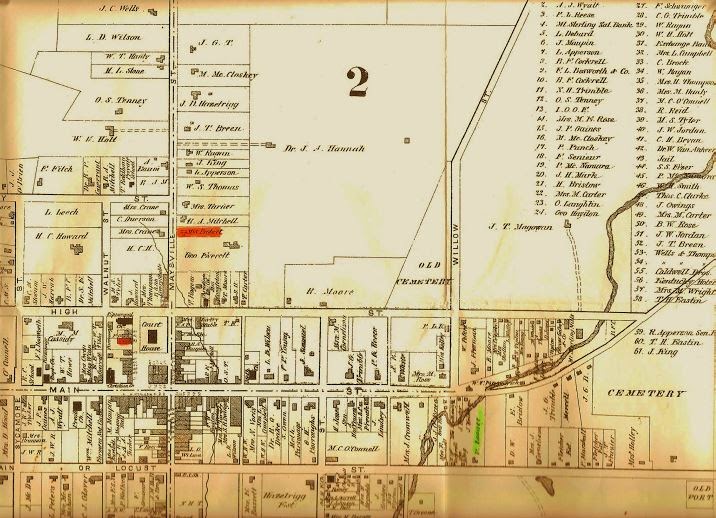
Map of Mt. Sterling, 1879
Four months ago, I closed the chapter on the first phase of Thomas Probert's life. He was acquitted in the shooting of Jacob Spears. Shortly after his acquittal, he married Catherine Richardson, and the new family moved to Mt. Sterling, Montgomery County, Kentucky.

If you recall, Thomas began his career in Lexington as a "confectioner." This was the trade he took up in Mt. Sterling.

According to a History of Mt. Sterling, Kentucky, 
. . . the earliest baker to build a significant reputation in the community was Thomas Probert, who was in Mt. Sterling by 1859. By 1871 he was listed as a confectioner and liquor dealer, and apparently went completely in the liquor business after that." p.184)
There are no records nor mentions in the newspapers in those first couple of years. On March 18th, 1860, Bettie B. was added to the family, joining two older half-sisters. This was "Kate's" first child. Unfortunately, their time of great joy was to be short-lived, as Bettie died seven months later. A son, Col. Speed Fry, was born on February 14th, 1862. Col. Speed Fry was Thomas' first surviving son -- but he, too, would die young, living only 3 1/2 years. Maggie O. was born in 1864, but would also die just short of her first birthday. Col. Speed Fry and Maggie died within two months of each other. Kate, stepmother to Addie and Lucy, was yet to have one of her own children survive to the age of four. I can't imagine the pain.

Sleep little darlings, sleep.
Not in the cradle bed.
Not on the Mother's breast
But with the quiet dead.
Source:


History of Mt. Sterling, Kentucky, 1792-1918. Carl B. Boyd and Hazel Mason Boyd, 1984.

Tuesday, September 23, 2014

It's Time to Recap

We're about to begin a new chapter in the life of Thomas H. Probert. As discussed in a previous post, Thomas was acquitted of the murder of Jacob Spears in February, 1859. The actual shooting took place in April, 1856, so this had consumed his life for almost three years. I have no information on how (or who) took care of his two daughters during his time in jail and while he was out on $2500 bail. At the time of his acquittal, his two girls, Addie and Lucy, were eleven and six years old.

I think that 21-year old Catherine "Kate" Probert may have had something to do with the girls' child care. Kate was born in Paris, Bourbon Co., Kentucky and was almost 13 years younger than Thomas. The Louisville Daily Courier carried the news of Thomas' acquittal on February 12, 1859.


On February 22, 1859, just ten days after the acquittal, Kate and Thomas were married in Paris, Kentucky. They took up residence in Mt. Sterling, Montgomery Co., about 15 miles from Paris. A fresh start in a new town was just what was ordered.


Initially, Thomas appeared to support himself as a baker. According to a History of Mt. Sterling, Kentucky, 
. . . the earliest baker to build a significant reputation in the community was Thomas Probert, who was in Mt. Sterling by 1859. By 1871 he was listed as a confectioner and liquor dealer, and apparently went completely in the liquor business after that." p.184)
This was an occupation Thomas had also practiced as a young man in Lexington.  So what would be the new chapter Thomas and Catherine would write in Mt Sterling?

Sources
"Kentucky, County Marriages, 1797-1954," index and images, FamilySearch (https://familysearch.org/pal:/MM9.3.1/TH-1-9999-17840-48?cc=1804888 : accessed 23 Sep 2014), 004542764 > image 217 of 343; citing Madison County Courthouse, Richmond.

History of Mt. Sterling, Kentucky, 1792-1918. Carl B. Boyd and Hazel Mason Boyd, 1984.

Wednesday, July 9, 2014

The Indictment

Photo Credit: Chicago Tribune Illustration

Murder in Bourbon

"We understand that on Monday, a difficulty occurred in the bar room of the Bourbon House (Mrs. Thurston's) at Paris. Jacob Spear, Esq., a well-known citizen, threw a glass of whisky in the face of  Thos. Probert, the bar keeper, who instantly drew his revolver and shot Spear (sic) three times through the head. The wounds caused immediate death. Probert was arrested and lodged in jail to await an examination."

Louisville Daily Courier, 4-26-1986. p. 1, col. 4.

I find this short synopsis interesting, because it contradicts the larger narrative in several subtle ways:
  • It speaks of a "difficulty" without any background.
  • It claims Probert drew his revolver as if it was his, instead of one kept on the counter of the bar.
  • It claims Spears was shot "three times through the head"
  • It claims Spears died immediately
  • It totally ignores the fact that Probert asked to be taken to jail for his own protection
The Daily Dispatch (Richmond, Virginia)

The shooting was newsworthy enough to justify a blurb in the Daily Dispatch, (Richmond, Virginia), on April 28, 1856:

"Jacob Spear, Esq, a well-known citizen of Paris, Ky., was shot dead on Monday in a bar room by a man named Probert."  

Courts were not held daily as happens now. In fact, they typically met once every three months. This is evidenced by this article published in the Louisville Courier on July 19, 1856.

Kentucky News

The July term of the Bourbon Circuit Court for the trial of criminal and chancery cases opened on Monday. On Tuesday, the grand jury brought into court an indictment against Thos. Probert for the murder of Jacob K. Spears, and in the afternoon of the same day the trial was commenced. A jury was obtained by 12 o'clock on Wednesday of the term, which closes on Saturday.

The prosecution is conducted by F. Kennedy, attorney for the Commonwealth, assisted by Capt. Hawes, R. W, Woolley, of Lexington, R. H. Hanson and Capt. Simms. The prisoner is defended by Mr. Davis, Mr. Alexander and Col. Martin.

Comment

This had to be a BIG trial -- four prosecutors and three defense attorneys?  More on that in the next post.

Monday, July 7, 2014

1854 - It Was A Very Bad Year

Thomas lost his father at the age of 13. His father, William, died on the way back home from the War for Texas Independence in 1837. By the age of 25, he was the head of a household in Lexington that included his mother, young pregnant wife, first-born daughter, 15-year old younger brother and two workers from his bakery.

Note how "Probert" was transcribed incorrectly.

Everything changed in 1854. In the previous post, we know his mother died in Louisville, Kentucky of cancer. She was living with her daughter. His wife died shortly after the birth and death of their first-born son, Thomas. By the end of 1854, Thomas was a 30-year old orphan and widower with two little girls aged two and four. I can't imagine what his options (or lack of options) were.

Sometime between his wife's death and 1856, Thomas relocated to Paris, Bourbon County, Kentucky -- not far from Lexington. I do not know if he had family connections there, but not long after his arrival, Thomas became the baker for the primary hotel in town called the Bourbon House. According to a newspaper article published in 1856, "Probert had been the baker for the hotel and had acted as bar keeper for two or three months."

Bourbon House*
Citizen Advertiser, 24 April 1977

Note: The picture of the Bourbon House was reprinted in 1977.However, the cars have been dated to 1928-1935, approximately 75 years after the events discussed above.

It is possible that Thomas knew the family of his soon-to-be second wife, Catherine Richardson, as she was living in Paris at this time. But as readers of this blog know, life was to take a terrible turn (next post).


The Citizen Advertiser published a story  on April 24, 1977 describing the fire that destroyed what was then known as the Windsor Hotel. The story was based on files of the Kentuckian Citizen dated January 30, 1945.

Fire of undetermined origin yesterday gutted the three-story, 81-room Windsor Hotel, Main and Second Streets, which has stood as a landmark in Paris for 140 Years. The blaze was discovered about 4 p.m., coming from a linen closet on the second floor and spread rapidly to the entire front of the building and south wing. In about two hours the front part of the roof and the roof over the wing had caved in, as well as the floors. . . . The walls are said to be 18 inches thick, and at present are supported by ice which has formed by water from fire hoses.

History of the Hotel

"The hotel was built in 1804-5 by Maurice Langhorn and was called the 'Indian Queen House.' Outside hung a sign depicting a beautiful Indian girl. Later the hotel was sold to Major Aris Throckmorton, a wealthy Virginia landowner (1789-1866), who ran the hotel on a lavish scale and he, in 1840, built the present dining room and parlor. The original woodwork was still in these rooms. He later went to Louisville where he erected the Galt Hotel. 

Daniel and Henry Turney bought the hotel here and made extensive improvements, building the present front. In 1854 the first railroad came to Paris and built its depot behind the hotel. The hotel was the center of social functions at this time and its name had been changed to Bourbon House. During the old Bourbon County Fair, one of the oldest in the country, famous balls were held there."

Tuesday, May 13, 2014

Young Parents -- Thomas and Mary Elizabeth

Thomas and Mary Elizabeth were married on December 23, 1846. By 1848, they were parents of a little girl. Although early records list her name as "Atlanta" (I'd love to know the story behind that), later records use the nickname "Addie." Within two years, Lucy was born to the family. She is of particular interest to me because she is my great-grandmother. What I wouldn't give for a baby picture.

Lucy Probert
I can only imagine the joy followed soon after by sorrow, when their first-born son, Thomas, was born. I don't know how long Thomas lived, but their must have been complications. Little Thomas was buried in the Lexington Cemetery on November 21, 1854 followed a week later by the burial of his mother on November 28, 1854. I assume she died from the complications of childbirth.


Lexington Cemetery Record
Records like this always break my heart. Of the eleven family members buried here, two are children and two are infants. Baby Thomas is buried at the feet of his mother.

Grave of Mary Elizabeth Probert and Infant Son, Thomas
Thomas was 30 and a widower with two young daughters. Mary Elizabeth died at the age of 29.

A couple of months earlier, Thomas also lost his mother. She was only 51 years old and was living in Louisville with one of her daughters at the time of her death from cancer.


Kentucky Death Records, 1852-1953, Louisville, Jefferson Co., p. 3.

As any parent of two young children knows, you need a support system. Where was Thomas' support?
Next Up: The move to Paris, Bourbon County, Kentucky.

Monday, May 12, 2014

Thomas -- Young Husband and Entrepreneur

The next time Thomas appears in the public record is as a young husband to Mary Elizabeth Diamond. They were married in Lexington on December 23, 1846. The marriage was reported in the Lexington Observer and Reporter. Both the bride and the groom were of Lexington. Thomas was 22 and Mary Elizabeth was 21 years old at the time of their marriage.


Thomas initially supported his young family as a baker. The 1850 Census showed that Thomas was not only supporting his young wife and first-born daughter Atlanta (aka Addie), but also his widowed mother, Mary, and younger brother, William. William, John Bridges and Bow Higginbotham are listed as bakers and apparently living in the same residence.

Source Citation: Year: 1850; Census Place: District 2, Fayette, Kentucky; Roll: M432_199; Page: 200B; Image: 178.

His bakery appeared to be quite successful as this notice was published in the Kentucky Statesman on March 30, 1850. 

Published in Kentucky Ancestors, Vol. 39. p. 183.


All seemed well for the young family. Thomas, who was left fatherless at the young age of 13 appeared to have stepped up to the plate and was quite responsible at the age of 25. What could possibly go wrong?

Note: The spelling of "Diamond" has appeared both with and without an "a" in  various records. The family that survives has chosen to spell it with an "a."

If you want to know when a new post is available, simply supply your email in the box provided on the right-hand menu bar.. You will be automatically notified when a new post is published. Thanks for following along.


Monday, May 5, 2014

Thomas -- The Early Years

Credit: Wikipedia.com
Thomas H. Probert, the son of William and Mary (Polly), was born on August 29, 1824. Until I discovered a digital copy of a marriage record for Thomas and his second wife, Kate, I had no idea that he was born in Hartford, Ohio County, Kentucky. In fact, I was surprised to learn that there was an Ohio County in Kentucky. It is about a four-hour drive from Cincinnati, located south of Evansville, Indiana.

The family had moved to Nicholasville, Kentucky just outside of Lexington where they were listed in the 1830 Census. Within four years, the family was listed in Lexington, where William initially made his living as a baker.

By the time William volunteered to be a fife player as part of a Lexington contingent of men who volunteered for the War of Texas Independence in 1836, William was working as a tailor.

Thomas was the first-born of five children, although one daughter, Sarah Elizabeth died at 18 months. He was only 12 years old when his father left for the war, and he had to grow up quickly. We are fortunate to have copies of correspondence from William to his wife in which it becomes obvious that William valued education. In a letter sent to his wife, Mary, dated  December 1836, William stated, "I am happy to know that you are doing so well as what you are and likewise that Thomas is able to help you a little. I hope he will be a good boy. I am very sorry to hear that William got his hand burnt, but I hope it is not injured much.  I am glad likewise that Nancy Jane is improving in her schooling. I would be glad if you could spare Mary Ann so that she could go to school, but these things I shall leave to your own good management."

Letters on file with the Texas Archives


In a second letter dated January 1937, William stated, "I hope you will endeavor to keep the children to school and expect that before my return I shall see a letter of Thomas' own writing."


I wrote about William's participation in the War for Texas Independence in several previous posts. What was unknown to all concerned was that life was about to get much more difficult. On William's return trip to Lexington via New Orleans, he succumbed to illness and died. Thomas was only 13 years old and the oldest of four children of a widowed mother. Things had to be tough.

Sunday, May 4, 2014

Fifty Shades of Thomas Probert


No doubt about it. I have "favorite" ancestors. Thomas H. Probert, who always signed his name as T.H. Probert, is one of those. He is a paternal gg-grandfather to me, grandfather to Norine, father of nine, and husband of two. Although I've written about him before (links below), he still draws me in, "forcing" me back to the Kentucky Archives and historical newspapers, trying to understand who Thomas was. Although I've not yet read the runaway bestseller Fifty Shades of Gray, the title of the book  fits with my notion of Thomas. You could never describe one or two "facts" about Thomas and think you've figured out who he was. He is a complex man, and that's why I love him.

So after four months of research, I'm ready to write. I hope you'll follow along on this journey and tell me if Thomas speaks to you. Want to be overwhelmed? Try to imagine how many direct descendants of T.H. are currently walking this planet. I'm glad to be one of them.

Need to catch up? Here are links to previous posts I've written about Thomas H. Probert.

Sometimes There Are Surprises
Where I've Been
You Be the Jury - Guilty or Not Guilty
You Be the Jury - Guilty or Not Guilty - Part 2
The Verdict Is In

Monday, July 25, 2011

Six Degrees of Separation

Credit:  Wikimedia.com
In a conversation on google+ a few days ago, Megan Smolenyak asked whether or not two cousins could be connected within 6 degrees?  To quote Wikipedia, "Six degrees of separation refers to the idea that everyone is on average approximately six steps away from any other person on Earth, so that a chain of, "a friend of a friend" statements can be made, on average, to connect any two people in six steps or fewer.

One of my favorite ancestors, and the one who piqued my interest in genealogy, was my paternal gg-grandfather, Britton Wainright.  He died of heatstroke on July 9, 1863 when, as a member of the Indiana Home Guard, he and others marched to confront John Hunt Morgan of Morgan's Raiders.  I've written extensively about Britton in a series of posts

Click to enlarge


Over the years, Morgan's story has become larger than life.  It seems like everywhere I go, I am confronted with reminders.  The bike trail I ride on has an historical marker recalling the spot where Morgan and his raiders attacked a train.

Last October, my cousin Barbara and I, traveled to Mt. Sterling, Kentucky to research our Probert ancestors and attend a meeting of the Mongtomery County Genealogical Society.  Following the meeting, we were able to get in the Historical Society.  They had a traveling exhibit of some of Morgan's artifacts on display, including his saddle. One of the members helped hold out part of the saddle where Morgan's information was embossed.

General John Hunt Morgan
2nd Kentucky Cavalry
1863
So last Friday, I traveled to the Lexington Cemetery to track down the grave of a gg-grandmother, Mary Elizabeth Dimond Probert, from a totally different paternal line.  I had forgotten that this cemetery was also the burial location for John Hunt Morgan, his parents, and many other Morgan family members.

Grave of John Hunt Morgan
(Note the Confederate flag at the base)
Morgan Family Plot

The parents of Morgan have a substantial monument and are surrounded by a circle of graves of their children. This memorial is not 100 yards from the gravesite of my grandmother where a Union fatality of the Civil War is buried.  When we were in Mt. Sterling, we were told of both Union and Confederate forces being in Mt. Sterling at the same time shooting at each other.  As a result of one of these encounters, the Court House was burned.

So back to the six degrees of separation game.  I guess I can connect my gg-grandfather, Britton, to my gg-grandmother, Mary Elizabeth.  1) Britton died marching to confront Morgan. 2) Morgan is buried in Lexington Cemetery. 3) Mary Elizabeth Probert is buried about 100 yards from Morgan.  And an additional link -- Morgan was in Mt. Sterling when my gg-grandfather, Thomas Probert, was living there.  Does the game work for dead people?

Sunday, July 24, 2011

A "Diamond" in the Rough

As mentioned in the previous post, I had the opportunity to travel to Lexington to research my gg-grandmother, Mary Elizabeth Dimond Probert. I'd only known about her for less than a year.  She was the first wife of my gg-grandfather, Thomas H. Probert, and mother of my g-grandmother Lucy.  In a search of the online Lexington Herald newspaper, I had found a marriage announcement for my gg-grandparents.


(Spelling:  Dimond)

A search of the Lexington Cemetery turned up a burial record for Mary and her newborn son, Thomas. Thomas was buried in the same plot a week earlier.

I was able to find a census record for Mary Elizabeth's father, Joseph, in the 1840 Census. (Spelling:  Dimond)


Same for the Marriage Record from the Kentucky Marriage Index. (Spelling:  Diamond)


A trip to the Lexington Cemetery found everyone in the plot using the "Diamond" spelling.  Yet a review of the Lexington City Directories from the early 1800s to 1902 showed members of the same family with the surname spelled both ways.

Thanks to correspondence with a member of the Ancestry.com community, I felt like I would be able to identify the branch of the Diamond/Dimond family from which Mary Eliz. descended.  I set up a spreadsheet and logged in every person whose surname was spelled either way. Then I was able to narrow my data base to those "Diamonds" that descended from Joseph and Mary Elizabeth.


I knew who Mary Elizabeth's siblings were.  The list posted above is comprised only of her siblings, their spouses, and in a few cases, their children.  I noted that both A.C. (Augustus Charles) and his brother, Richard, made their living drilling wells. David, a member of the next generation, got into the family business.

With this information in hand, my next job will be to research other family members. The cemetery record listed James L. Diamond as the owner of the plot.  There is evidence that James lived in Kentucky, Illinois, Missouri, and then returned to Kentucky.  One census document states that James' father was born in Massachusetts.   I'd say that is quite a lot of clues for one day's work.