Showing posts with label Mt. Sterling. Show all posts

Thursday, February 12, 2015

Reflections on "Race" in Mt. Sterling in the 1860s

Visit to Mt. Sterling in 2001 with Tim Jones
When I initially started researching the Proberts in Mt. Sterling, it involved several trips to the Recorders Office in Montgomery County. I remember my shock when among the ledgers where deeds were recorded were groups of books labeled "Colored" on the shelf. I guess my shock was noticed by one of the other patrons. She asked me where I thought I was and stated that the population of Mt. Sterling around the period of the Civil War was about 50/50 black/white. The ramifications were only beginning to sink in.


Population in 1870


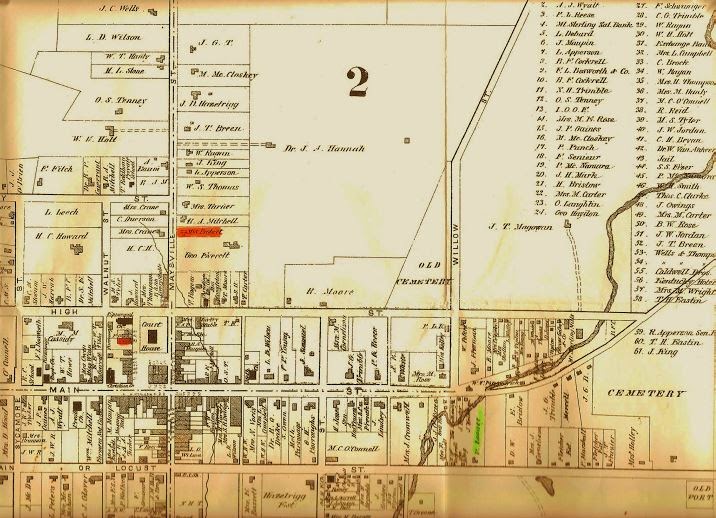
According to a map of Mt. Sterling in 1879, the population of Mt. Sterling was made up of 597 white and 448 black people (57% vs. 43%). Note that this census is five years after the slaves were "freed."
Here is what I know:

1860 Census


In the 1860 Census, Thomas' household includes his wife, 3 children, brother-in-law, and "Hampton." Hampton does not have a surname listed and is also listed as a man of "color." This was shortly after Thomas moved to Mt. Sterling and he was earning his living as a "confectioner." I am assuming that Hampton was a slave, but he did not belong to Thomas as verified by a check of the 1860 Slave Schedules. Slaves were often hired out by their owners to work in certain trades, and I think this is a possibility here. Hampton may have worked at the bakery with his wages going to his owner. It will take more research to verify my assumptions.


Serving Liquor to a Slave

As mentioned earlier, Thomas was indicted in 1864 for "serving liquor to a slave." Here is a copy of the indictment:


Transcription: On the ? day of August, 1864, in the County and Circuit aforesaid did unlawfully sell, loan and give to Jack the slave of Samuel Edger and wife, spiritous liquors, whiskey and brandy without having the written permission so to do from the owners. masters of any one having the custody and control of him for the time being entitled to the custody or services of the said Jack by contract with the owner or anyone having the control and custody of him.
It's hard for me to imagine another human being considered to be "property," but this was the reality of the times. It makes me wonder whether or not Jack knew his circumstances would change in the near future. What's interesting is that Jack was not impacted by Lincoln's "Emancipation Proclamation" issued on January 1, 1863. According to Wikipedia, "The Proclamation applied only to slaves in Confederate-held lands; it did not apply to those in the four slave states that were not in rebellion (Kentucky, Maryland, Delaware, and Missouri, which were unnamed), nor to Tennessee (unnamed but occupied by Union troops since 1862) and lower Louisiana (also under occupation), and specifically excluded those counties of Virginia soon to form the state of West Virginia." 

Acknowledging the Truth

I have never been able to prove that Thomas was a slave owner. However, I must admit to my own shock when I uncovered this deed. I was researching all of the deeds for Proberts and related family to see what had been purchased and how much it cost. In the Recorders Office, I was able to get a copy of the deed for the purchase of the building that was used for the "confectionery shop" in 1863.


If you notice in the section labeled "price paid," that Thomas paid "nine hundred dollars, four hundred fifty dollars of which is to be paid on the 8th day of July, 1864, and the remaining four hundred and fifty dollars on the 8th day of December 1864." Part of the purchase price, however, was a negro boy named Harry. On this day, Thomas H. Probert "sold, delivered and transferred, all right, title and interest in and to a certain negro boy named Harry to the party of the first part."

At times, I wish I had never found that document, but on the other hand I believe that we, as a country, must collectively assume responsibility for what we were willing to do to human beings at this time. Sometimes, in my mind, I think of this period of time as something that like the Holocaust, we have a duty to "Never Forget." More importantly, we must acknowledge the impact that the legacy of slavery has on our society today and make every effort to ensure justice and opportunity for us all.

Saturday, February 7, 2015

Probert Elected Jailer!

Entrance to Jail with Miles Hoskins, Montgomery Co. Historical Society

So if you can't beat the government, why not join them? It will become apparent in future posts that Thomas was popular among the citizenry of Mt. Sterling. However, in this post Civil War town, it was becoming nearly impossible to support his family with a "coffee house." Fines were becoming too costly and the Commonwealth revoked his license to run a coffee house. So what to do next? RUN TO BE COUNTY JAILER!


Published in the Mt. Sterling Democrat 8-7-1866 and reprinted in the Cincinnati Enquirer

There are a couple of significant things to notice in this article. We have evidence that Thomas Probert was pro-union at the beginning of the Civil War. After all, he named his son after a famous Union Colonel. The war was conducted by President Abraham Lincoln, a Republican. But five years later, the political climate had completely flipped. Note that "the Democrats have elected all the county officers." Note also that "Radicalism has fizzled out in this county." The sweep of the Democrats in this election represented a sea change of politics in this area.

Thomas and his elected representatives would have their names published daily in the Mt. Sterling Democrat as part of a County Directory. Thomas emerged from the war with a steady job and income running the jail. He would keep this position until his death. 

Mt. Sterling Democrat published 12-24-1868

So what do we know about the jail?

Monday, February 2, 2015

A Fresh Start in Mt. Sterling, Montgomery Co., Kentucky

Map of Mt. Sterling, 1879
Four months ago, I closed the chapter on the first phase of Thomas Probert's life. He was acquitted in the shooting of Jacob Spears. Shortly after his acquittal, he married Catherine Richardson, and the new family moved to Mt. Sterling, Montgomery County, Kentucky.

If you recall, Thomas began his career in Lexington as a "confectioner." This was the trade he took up in Mt. Sterling.

According to a History of Mt. Sterling, Kentucky, 
. . . the earliest baker to build a significant reputation in the community was Thomas Probert, who was in Mt. Sterling by 1859. By 1871 he was listed as a confectioner and liquor dealer, and apparently went completely in the liquor business after that." p.184)
There are no records nor mentions in the newspapers in those first couple of years. On March 18th, 1860, Bettie B. was added to the family, joining two older half-sisters. This was "Kate's" first child. Unfortunately, their time of great joy was to be short-lived, as Bettie died seven months later. A son, Col. Speed Fry, was born on February 14th, 1862. Col. Speed Fry was Thomas' first surviving son -- but he, too, would die young, living only 3 1/2 years. Maggie O. was born in 1864, but would also die just short of her first birthday. Col. Speed Fry and Maggie died within two months of each other. Kate, stepmother to Addie and Lucy, was yet to have one of her own children survive to the age of four. I can't imagine the pain.

Sleep little darlings, sleep.
Not in the cradle bed.
Not on the Mother's breast
But with the quiet dead.
Source:


History of Mt. Sterling, Kentucky, 1792-1918. Carl B. Boyd and Hazel Mason Boyd, 1984.

Tuesday, September 23, 2014

It's Time to Recap

We're about to begin a new chapter in the life of Thomas H. Probert. As discussed in a previous post, Thomas was acquitted of the murder of Jacob Spears in February, 1859. The actual shooting took place in April, 1856, so this had consumed his life for almost three years. I have no information on how (or who) took care of his two daughters during his time in jail and while he was out on $2500 bail. At the time of his acquittal, his two girls, Addie and Lucy, were eleven and six years old.

I think that 21-year old Catherine "Kate" Probert may have had something to do with the girls' child care. Kate was born in Paris, Bourbon Co., Kentucky and was almost 13 years younger than Thomas. The Louisville Daily Courier carried the news of Thomas' acquittal on February 12, 1859.


On February 22, 1859, just ten days after the acquittal, Kate and Thomas were married in Paris, Kentucky. They took up residence in Mt. Sterling, Montgomery Co., about 15 miles from Paris. A fresh start in a new town was just what was ordered.


Initially, Thomas appeared to support himself as a baker. According to a History of Mt. Sterling, Kentucky, 
. . . the earliest baker to build a significant reputation in the community was Thomas Probert, who was in Mt. Sterling by 1859. By 1871 he was listed as a confectioner and liquor dealer, and apparently went completely in the liquor business after that." p.184)
This was an occupation Thomas had also practiced as a young man in Lexington.  So what would be the new chapter Thomas and Catherine would write in Mt Sterling?

Sources
"Kentucky, County Marriages, 1797-1954," index and images, FamilySearch (https://familysearch.org/pal:/MM9.3.1/TH-1-9999-17840-48?cc=1804888 : accessed 23 Sep 2014), 004542764 > image 217 of 343; citing Madison County Courthouse, Richmond.

History of Mt. Sterling, Kentucky, 1792-1918. Carl B. Boyd and Hazel Mason Boyd, 1984.

Monday, July 25, 2011

Six Degrees of Separation

Credit:  Wikimedia.com
In a conversation on google+ a few days ago, Megan Smolenyak asked whether or not two cousins could be connected within 6 degrees?  To quote Wikipedia, "Six degrees of separation refers to the idea that everyone is on average approximately six steps away from any other person on Earth, so that a chain of, "a friend of a friend" statements can be made, on average, to connect any two people in six steps or fewer.

One of my favorite ancestors, and the one who piqued my interest in genealogy, was my paternal gg-grandfather, Britton Wainright.  He died of heatstroke on July 9, 1863 when, as a member of the Indiana Home Guard, he and others marched to confront John Hunt Morgan of Morgan's Raiders.  I've written extensively about Britton in a series of posts

Click to enlarge


Over the years, Morgan's story has become larger than life.  It seems like everywhere I go, I am confronted with reminders.  The bike trail I ride on has an historical marker recalling the spot where Morgan and his raiders attacked a train.

Last October, my cousin Barbara and I, traveled to Mt. Sterling, Kentucky to research our Probert ancestors and attend a meeting of the Mongtomery County Genealogical Society.  Following the meeting, we were able to get in the Historical Society.  They had a traveling exhibit of some of Morgan's artifacts on display, including his saddle. One of the members helped hold out part of the saddle where Morgan's information was embossed.

General John Hunt Morgan
2nd Kentucky Cavalry
1863
So last Friday, I traveled to the Lexington Cemetery to track down the grave of a gg-grandmother, Mary Elizabeth Dimond Probert, from a totally different paternal line.  I had forgotten that this cemetery was also the burial location for John Hunt Morgan, his parents, and many other Morgan family members.

Grave of John Hunt Morgan
(Note the Confederate flag at the base)
Morgan Family Plot

The parents of Morgan have a substantial monument and are surrounded by a circle of graves of their children. This memorial is not 100 yards from the gravesite of my grandmother where a Union fatality of the Civil War is buried.  When we were in Mt. Sterling, we were told of both Union and Confederate forces being in Mt. Sterling at the same time shooting at each other.  As a result of one of these encounters, the Court House was burned.

So back to the six degrees of separation game.  I guess I can connect my gg-grandfather, Britton, to my gg-grandmother, Mary Elizabeth.  1) Britton died marching to confront Morgan. 2) Morgan is buried in Lexington Cemetery. 3) Mary Elizabeth Probert is buried about 100 yards from Morgan.  And an additional link -- Morgan was in Mt. Sterling when my gg-grandfather, Thomas Probert, was living there.  Does the game work for dead people?

Thursday, April 28, 2011

The Last Word on John Cronin

Note:  This is the 4th post in a series of posts about John Cronin, the husband of my g-grandmother, Lucy.

The first place I traveled to in search of John Cronin was the town of Paris, Bourbon County, Kentucky based an a newspaper article I had discovered in the Kentuckiana Digital Library.  A visit to the Paris-Bourbon Co. library revealed a second article that gave several more clues as to the "real" John Cronin.
Here is a transcription:

True Kentuckian, Paris, Kentucky, April 5, 1882

John Cronin, who committed suicide at Mt. Sterling last Saturday night by morphine, was buried in the Catholic cemetery here on Monday.  His father owns a lot in the cemetery, but it being contrary to rules of that church to inter a suicide in consecrated ground, he was buried in the strangers' lot.  He was born and raised in Cynthiana, having been here three or four years ago exhibiting the two Elam children, or "Scaly Brothers," human curiosities from one of the mountain counties.  Three or four weeks ago, while acting as Marshal of Mt. Sterling, he shot and wounded a Mr. Conner, for which he was under bond.  He left a wife and 5 small children.  His widow is a daughter of Thomas Probert, deceased, formerly of this city, she being the offspring of Mr. Proberts first marriage,  Mr. P.'s second wife being a sister of Thomas Richardson, Sr., of this place.

Finally, the Mt. Sterling Sentinel Democrat, 4-14-1882, p. 2 reports the following:

"The body was buried and reburied until Father Barry told Mr. Cronin, the brother, that he could either take the body from the cemetery or leave it where it lay, in unconsecrated ground, or take all the bodies from the Cronin lot and the money that was paid for it would be refunded.  Cronin cursed the entire congregation, and defied any man to step from the crowd, numbering 80 or 90 men, to stand before him, which polite invitation was, as a matter of course, declined.  It was thought that the body will be brought here (Mt. Sterling)".

I've yet to find out where he is buried -- if moved again, it would mean four burials for poor John Cronin.

John Cronin was the husband of my great-grandmother, Lucy Probert Cronin.  Lucy later had one more child, my grandmother, with William Dailey of Mt. Sterling.  All six children were eventually raised in orphanages.  I can't even imagine the difficult life Lucy had, nor can I imagine having to give up all six children.  I wish Lucy could have been blessed with an easier life, but it is testimony to Roman Catholic nuns that all six children went on to lead productive lives.

The Romanticization of John Cronin

I wanted SO much to believe that John Cronin was a good guy -- and maybe he was.  But the evidence isn't pointing in that direction. 

Two days ago I got to live the dream of every family historian and travel to the places in Kentucky I knew John Cronin had lived -- Paris, Bourbon Co., Mt. Sterling, Montgomery Co., and Cynthiana, Harrison Co.  Armed with the approximate date of John Cronin's suicide and the shooting of Richard O'Connor that may have led to this decision, my goal was to check any local newspapers to see if I could get a more complete picture.  What a day it was!

I decided to create a timeline of the events culled from several articles:

3-10-1882 - The Democrat - Mt. Sterling, p.2.
  • John Cronin and Richard O'Connor "collided on the street and both turned and began an angry altercation."
  • John Cronin "drew a pistol and fired at O'Connor five times, one ball taking effect in O'Connor's left side, in the abdomen."
  • The statements of the participants were "so divergent" that the newspaper could not "attempt to give any further particulars."
  • The trial was set for Thursday morning. 
3-14-1882 - The Democrat - Mt. Sterling, p.2.
  • "The attention of the Police Court was occupied all day Monday with the trial of John Cronin for wounding Richard O'Connor with intent to kill."
  • "Quite a number of witnesses were examined on both sides, but on account of the absence of several important witnesses the trial was adjourned."
  • "The Court adjourned to the house where the wounded man is staying.  He was very feeble and could scarcely give his testimony."
3-17-1882 - The Democrat - Mt. Sterling, p.2.
  • The trial was concluded in City Court.  "The Judge then delivered his opinion which was that the defendant had acted too hastily and that there were good reasons for holding him over to the grand jury."
  • The Judge "softened the charge" since he did not believe " there was any malice aforethought proven in the case."  Cronin was to be held over under the charge of "unlawfully shooting."
  • His bail was fixed at $800, which he gave.  Patsy McNamara was his bondsman.
4-4-1882 - The Democrat - Mt. Sterling, p.2.
  • The paper reported on the death of John Cronin by suicide on April 1, 1882.  (Note:  This is my birthday as well as April Fool's Day).
  • He took his life by overdosing on morphine.
  • He was described as handsome and about 33 years old. 
There is no way I can do this part of the story justice without including the actual article.  Since it is difficult to read, here is the transcription:

In the Jaws of Death

An occurrence, as startling as it was sad, shocked the entire community Saturday night.  This was none other than the suicidal death of John Cronin.  Cronin lived on Maysville street with his family and worked hard all day Saturday.  He appeared light-hearted and good-humored and not a breath of suspicion was held by any of the dreadful resolve centered in his mind.  After supper he said to his wife that he had the blues and was going up town and get drunk.  She begged him not to do so, and he replied that if she would send up and get him some morphine he would stay at home and go to sleep.  She sent up and got him two grains of this narcotic which he took after he had washed and dressed himself.  He then lay down on the bed.  Calling his little son to him he said "come lay on the bed here, for it is the last time you will ever sleep with your father."  They nestled up together and lay there for about five minutes, when Cronin petulantly observed that the morphine was "no account" and that he would have to get more before he could sleep.  He then got six grains more which he took, this being the fatal dose.  This was at a few minutes after nine.  He fell over on the bed and his wife suspecting he had taken an overdose sent immediately for Drs. Thornley and Glover, who labored with him faithfully but to no avail, for he died at 25 minutes past 10 o'clock.  His father lives in Cynthiana, and John King and John Feehan drove over there to summon him.  He arrived here Sunday afternoon.  The remains will be taken to Paris for burial.  Cronin was a handsome man, about 33 years old.  He was a tinner by trade, although he had not worked at it since he returned from Kansas.  His career had been a checkered one and numerous incidents are now related of his lawless life.  About a month ago he shot a man here in a street broil and this man is still stretched upon his bed.  Many are the motives assigned for the suicide, but the immediate cause will always be shrouded in mystery.  Sunday afternoon John McGilaway, Pat Sammons and Will Bradshaw went around and collected $35 for the family, which is in indigent circumstances.


As this post is getting to be quite lengthy, I will reveal the rest of my findings in the next post.  I'd love to hear your opinion of John.  Leave a comment.

Tuesday, April 19, 2011

John Cronin -- Buried Three Times - At Least!

Note:  Click here for a link to Part I of this story.

As I write this, I have such a jumble of emotions.  From what I can tell, John Cronin was probably a fine, upstanding member of the Mt. Sterling community.  He married Lucy Probert and together they had five children:  Joseph, Albert, Charley, Annie, and Addie.  He was respected enough to be a "Deputy Marshall."  So how could everything go so badly so quickly?*

I have to believe that the shooting of Richard O'Conner had something to do with pushing John over the edge -- but at what a cost to his wife and children.  I wonder if he would have acted differently if he would have seen how desperate the situation would become for his widow.  Within a year and a half, all five children were placed in an orphanage.  Lucy would feel compelled to leave town.  Perhaps there is more to the story than I know and John anticipated a trial that would not go well for him.  At any rate, he took his own life.

This caused a real dilemma for the burial of John Cronin because suicide prevented the Catholic Church of the time from allowing the body to be buried in "consecrated" ground.  I found this article that described the problem.
Paris, Bourbon County, Kentucky, Tuesday, 4-11-1882, Vol. 1, p. 1.
To summarize, John Cronin's body was buried in the Stranger's Section (unconsecrated ground) due to his suicide.  This infuriated John's younger brother, who together with the help of a brother-in-law, disinterred John's body and moved it to a plot owned by his father (consecrated ground).  The local priest telegraphed the Bishop of Covington for advice and was told that he would have to exhume the body and move it back.  John's brother returned from Cynthiana to confront the priest.  The article implies that they were working on a solution, but gives no indication of the final outcome.

So on this day, 129 years later, I hope John is at peace -- regardless of resting place.

* Additional research proved that it was Richard O'Conner who worked in the grocery store -- not John Cronin.  Perhaps his job at the time of his death was serving as a "Deputy Marshall".  He had once worked as a tinner (tinsmith).

The Elusive John Cronin - Part I

For ten years I have been trying to find out what happened to John Cronin -- husband of Lucy Probert and father of her first five children.  He is listed in the Mt. Sterling, Montgomery County, Kentucky 1880 Census with Lucy and the first four children.  Addie was born later on that year.

I knew that all five children were placed in an orphanage in northern Kentucky in 1884.  On the intake record for the boys, the father was listed as "dead."  That gave me a narrow window to search -- 1880 to 1884.  How hard could it be?

For ten years I have visited the Montgomery County Court House, visited the Kentucky Room at the Mt. Sterling library, searched online and searched digitized historical newspapers.  To make matters worse, there was another John Cronin married to Armilda Hubbard living in Mt. Sterling at the time.  Why couldn't I find my guy?

Last night I was searching through the Kentuckiana Digital Library for the umpteenth time looking for John Cronin.  I know from experience that it can be a tricky thing and that you must try every possible spelling and variation imaginable.  This time I hit pay dirt!

Semi-Weekly Interior Journal, Stanford, KY    4-21-1882
Committed suicide?  Why?  Why in Paris, Kentucky* if he was living in Mt. Sterling? Continued searching gave me more clues.  Apparently Richard O'Connor worked in a grocery.  John Cronin was a "Deputy Marshall."  According to a second article, John Cronin had had an altercation with one Richard O'Conner.  As Richard threw "weights" at John, John unloaded his revolver into Richard, hitting his left side and arm. I've not been able to discover any basis for the "bad blood" between them.

Bourbon news (Millersburg, Kentucky): 1881, p.4.

I don't know what Richard O'Conner's beef was, but he lived to die another day -- literally.


Evening Bulletin, Maysville, Kentucky, 3-8-1882.
The article makes it appear as if John Cronin succeeded in actually killing him this time, but I have my doubts.  I came across a marriage record in the Kentucky Marriage Index for a Richard O'Conner of Mt. Sterling, Kentucky in 1883.

 And then there is this notice in the newspaper . . .

Semi-Weekly Bourbon News, September 14, 1883, p. 1.
The article about the shooting does not say why Richard was shot, whether or not John Cronin was arrested, and whether or not there was a trial.  BUT WAIT -- THERE'S MORE!!!  The story takes yet another interesting twist. Be sure to read the next post.  John Cronin - Buried Three Times - At Least!

Note:  If you want to know what happened to John's widow, Lucy, go to this link.
*Additional research proved that John Cronin committed suicide in Mt. Sterling -- not Paris.

Monday, August 31, 2009

Where I've been . . .

August left me little time to blog. The first week of August I was involved in implementing a new course for teachers -- it was a great success. In addition to this, I didn't know what direction to take next. I'm to the generation of Joneses that includes my grandparents -- Jan and Pop as we knew them. I realized I just didn't know as much about them as I would have liked. I contacted Rosemary Kramer and Fred Breving and will post what I learn in a later post.

Meanwhile, I had the itch to get away and decided to go down to the Kentucky Archives in Frankfort, KY. I've been there before. It's an interesting place. You can pull up original documents, musty and moldy as they are, from Mt. Sterling, KY that were filed by T.H. Probert, Jan's grandfather (and our gg-grandfather). For years I've tried to research both William Dailey and John Cronin to determine who was Jan's father.


I was able to find some tax records from the 1880s, but no answers to my questions. I decided to drive over to Mt. Sterling and take some pictures. In an earlier visit to Mt. Sterling I had found the grave of T.H. (Thomas) Probert at the MacPhelah Cemetery on the outskirts of Mt. Sterling. I had a death record for him. He and his wife, Catherine Richardson, had lost three children as infants. The infants are buried on the same site.


There is one tall monument to the family. It is located in Section 9 and is near the top of a hillside that overlooks the entire town of Mt. Sterling. I always seem to be there just as the "golden hour" is upon us. I was touched by the quotation that was carved into the side of the marker.


My plan was to leave MacPhelah, take pictures in the heart of Mt. Sterling, photograph the grave of William Dailey in St. Thomas Cemetery and head back to Cincinnati. That's where things got really fun. I went to the center of town near the Court House and started taking pictures of the location where I know Thomas Probert had once served as the town jailer. In the 1870 Census, the Probert family is listed along with the names of the prisoners and a cook. Although I know the exact location of the jail, it is now the site of what is now the Historical Society for Mt. Sterling.


When I got there, there was a group of about 100 people attending a pot luck dinner. I found the door was open and went in to photograph a picture of the site when it was used as a fire station and then left. I was followed out by Miles Hoskins who is the president of the society and invited me in. They were having a speaker from the University of Kentucky, Becky Ryder, who was going to pick up originals of the Kentucky Sentinel, a weekly newspaper published in Mt. Sterling. She was going to take the originals, purchased by Miles in an estate sale, and have them digitized at the University of Kentucky. Once this process is completed, the papers will be posted on the web and be fully searchable. As someone who had just spent three hours at the library scanning microfilm of these historic papers, I can't imagine how helpful that will be.


Miles Hoskins is pictured with a copy of the Kentucky Sentinel, soon to be digitized and searchable online.

We all exchanged business cards and it was great fun sharing common history with Mt. Sterling residents. I know this will not be my last visit to Mt. Sterling. In fact I very much look forward to learning what I can and sharing what I have with the members of the Historical Society.