Saturday, July 28, 2012

In His Own Words . . .

Sometimes the stars just align -- and that is what happened to me. Land records are not exactly part of my comfort zone, but they have proved to be invaluable.  Thanks to records from the Texas Archives, I learned my ggg-grandfather, William Probert, had earned 4000+ acres of Texas land following his service in the War for Texas Independence from Mexico. Due to his year-long service, he was awarded certificates entitling him to claim 1280 acres -- 320 acres for each 3-month period of service.  In addition, he was given a "First-Class Headright" (see League and Labor).  as the head of a family in Texas in 1836.

In attempting to find out what happened to the land, I was fortunate to obtain copies of correspondence between William and his wife Mary (Polly) from the Texas Archives.  I no longer have to speculate as to why William chose to leave his wife and four young children to go off to Texas. I now know it was a decision supported by William's wife in the hopes that their family would be better off following his service.  Here is part of his letter in his own words transcribed below:


Transcription: But when I consider on the fortune that I have made in Texas, it gives me some comfort. There are several men that have come to the country and have stayed a short time, taken their discharge and by the time they return home, they have nothing to show for their service.  But I came here for a fortune and a fortune I will have -- five thousand acres of first-rate land will come very near it. We are waiting the glad tidings of peace every day and then we shall all come home with flying colors.


In a separate letter, William reiterated his hopes for his family's future.
I hope the time will soon come that we may again enjoy ourselves and see better times than we have seen yet. I believe that by coming to Texas is the best thing I ever did in my life for it will be a fortune to us and our children if it’s well-managed as long as we live. Dear Polly, I have to inform you that my pay is still to the good.  We have not drawn any money since we came to Texas and I should have been able to send you some according to the promise I made you.


William concluded the letter with the following: Dear Polly, I cannot at this time tell you how long it may be until the Army is discharged. But it will not be long as the fighting business is at an end between Texas and Mexico.  Try and comfort yourself as well as you can and give my love to my Dear Children and to all my old acquaintances. No more at present from your affectionate husband until death.

How many of us can say that our ancestors from 1836 could read and write? It is with joy that I share a copy of William's signature with you.


Note: I have taken the liberty to change some of the punctuation and spelling from these letters to conform with current practice.

Tuesday, July 24, 2012

I Was Wrong -- Once Again . . .

From the Letters of William E. Probert to His Wife, Polly   1836-37

A few posts ago, I suggested that my newly-discovered ggg-grandfather, William E. Probert, was a "poor" father for leaving his wife and four young children to be a "Fife Major" in the War for Texas independence. I could not think of any legitimate reason why a man would do this with his wife's agreement, knowing the burden that it would certainly be.

Once again, the amazing people at the Texas Archives were able to straighten me out. In discussing a "League and a Labor" in the previous post, I realized that it took an act of the Texas legislature for the Probert heirs to get the certificate for the 4000+ acres of Texas land that had been awarded to William.
I spoke with one of the archivists who suggested that I followup with a division that housed "Memorials and Petitions." Shortly after contacting them, I was told that they had a file that contained correspondence between W.E. and his wife, the names of his children, information on his discharge from the Texas Army, and documentation of his death. They told me I could have copies of the entire file for $3.66.
I COULDN'T BELIEVE IT!!!

My cousin, Barbara, and I then began a four-day vigil at our respective mailboxes. The information was priceless.  Not only did it provide proof that he was our ancestor, but it listed all of his children. And even better, I now knew why he was willing to leave his wife and children for this one-year period. I will discuss that in the next post.

I thought, however, that I needed to correct my perception about William E. Probert.  Throughout his letters, William spoke lovingly to his wife and expressed his desire to get back to her as soon as possible. He was concerned about their children and expressed interest in their schooling.  In true parental form, he asked for a letter from his oldest son, Thomas, in his own handwriting. He was making a sacrifice for what he and his wife believed would be of benefit to the whole family.

So, William, I'm glad to get to know you -- and I'm proud to have you for an ancestor.

Sunday, July 1, 2012

A League and a Labor?


Transcription:                                                                                   General Land Office
                                                                                                        Austin, April 8th 1854

This is to certify that the heirs of William E. Probert deceased are entitled to have surveyed by a legally authorized Surveyor upon any of the untouched and unappropriated public domain of the State of Texas. One League and One Labor of Said in accordance with the provisions of an act authorizing and requiring the Commissioner of the General Land Office to issue to the said heirs of William E. Probert deceased a Certificate for one league and one labor of land.  Passed February 8th,1854.
                In testimony whereof I hereunto set my hand and affix the Seal of said office the day and date first above written.  
                                                                                                         J. Crosby  

In 1854, eighteen years after William E. Probert first came to Texas, his heirs were entitled to a "First-class headright."  A document provided by the Texas General Land Office explains this land grant in this way:

Headrights, Republic of Texas, 1836-1845

In order to build a tax base and encourage settlement in the new Republic of Texas, immigrants were granted land by the government.  The amount of acreage issued was based on the time period in which an immigrant arrived in Texas.

First-class headrights were issued to those who arrived before the signing of the Texas Declaration of Independence on March 2, 1836. Heads of families were eligible for one league (4428.4 acres) and labor (177.1 acres) of land.

I do not understand how William qualified for a first-class headright as he did not arrive in Texas until June 1836. (Perhaps he signed up for service before the March date). It also appears that the certificate entitling William to his land was not issued until the Land Office was directed to do so as the result of a legislative appeal. This headright just like bounty land, was not connected to a specific parcel of land.It was up to the certificate holder to identify the potential property, have it surveyed and finally get it patented at the appropriate land office.

Of particular interest to me is the fact that the certificate was issued to his heirs.  Since William received 640 acres of bounty land on May 13, 1853, it suggests that William died between 1853 and 1854. Unfortunately,   the paperwork in my possession does not list any of the heirs. The next step will be to try to trace the deed that was based on this certificate.  Perhaps it will provide some valuable clues.                                                                    

Thursday, June 28, 2012

I Have to Admit I'm Confused

In the previous post I discussed how my ggg-grandfather, William E. Probert, was awarded 640 acres of land in exchange for his six months of service in the Texas War of Independence from Mexico.  What I don't understand is why he received an additional 640 acres from the State of Texas.  According to the certificate, it also was in exchange for his service.

Update: If you ever have the opportunity to talk with someone from the Texas General Land Office, I hope you are as fortunate as I am.  Today, "John" explained to me that William E. had actually signed on for another six months. He was, therefore, entitled to two land grants of 640 acres each. Apparently he sold the first one but kept the second one, reflected below.  However, he didn't have it for long.  This certificate was approved on May 13, 1853 and we know he was dead by February 8, 1854 (per the first-class headright that will be discussed in the next post).

Texas Land Grant
Approved May 13, 1853

A search of the newspapers of the time provides at least one clue. In the Texas State Gazette, (Austin, Texas), Vol. 4, No. 23, Ed. 1, Saturday, January 22, 1853, the original certificate was lost.  A representative of the Land Office explained to me that the procedure in this case was for an attorney to post this in the newspaper and then apply for a duplicate certificate if there was no response to the ad in the time period specified in the law. 


From December 4, 1852 until May 13, 1853, the process really moved quickly. The survey that was included in the documents stated: 
The State of Texas Milan Land District Survey No. 6 for Wm. E. Probert of 640 acres in Bell County on Cowhouse Creek about 32 miles above fort Gates being the quantity of land to which he is entitled by virtue of Bounty Certificate No. 1266.
The survey was verified as "correct" on April 28, 1853 and was patented by May 13, 1853.  There is no evidence, however, that Wm. E. Probert ever did anything with the land.  In fact, the patent was delivered to N.C. Raymond, probably an attorney representing Wm. E. Probert. 


The land issues were clearly not over as you will see in the next post.

Friday, June 22, 2012

Texas Land Records - An Education

I was SO excited when I received copies of land records in the name of William E. Probert from the Texas Land Office.  Understanding them was a whole different matter.


If you can believe it, anyone who served in the War for Texas Independence from Mexico was given 320 acres for every three months of service.  My ggg-grandfather was given 640 acres for his six-month participation as a "fife major."  If you look carefully at this certificate, William E. Probert was given 640 acres for his service by the REPUBLIC OF TEXAS (remember, Texas was its own country).  What's interesting about this certificate is that it was immediately "assigned" to Henry Kesler. In speaking to the fine people in the Texas General Land Office, I found out that the assignee was either someone William immediately sold the Bounty Grant to or an attorney representing his interests. He did not hire a survey or identify land he wanted. He did not keep the property.

So here is the procedure:

  1. Get a "certificate" issued by the government of the Republic or State of Texas. The certificate entitles the grantee to a certain number of acres of land in the unallocated public domain. These certificates could be sold or transferred.
  2. The second step was to hire a surveyor to identify the land that the certificate holder wanted to claim. After they survey was completed, the results of the survey would be submitted to the local land office to assure that there were no other claims on the land.  If not, on to Step 3.
  3. Pay a fee to get the land patented.  At this point the land is transferred from the government to the private sector. The whole process can take several years.
A representative of the Texas General Land Office told me that many grantees immediately turned around and sold the certificate.  At the time, land meant nothing.  One hundred dollars meant a lot.  Our William immediately "assigned" this certificate to Henry Kesler. Henry either purchased the certificate outright or was an attorney representing W. E.'s interests.

This certificate was issued in February of 1838 in Houston.  The land was granted for Trinity County and was finally patented January 21, 1842 -- a period of four years. No land for the Proberts.  But wait -- there's more . . .

Sunday, June 17, 2012

Why Would He Do It?

I've had a great time over the past couple of weeks researching my ggg-grandfather, William E. Probert.  The best information I have so far, is that he immigrated from Wales.  There is a debate as to whether or not he has "Irish" roots. In the process, I found out that the name "Probert" in the Welsh tradition frequently means "son of Robert."  Reminds me of my Jones maiden name, which often meant "son of John."

William and his wife Mary had five children.  The first, Thomas, was born in 1824 and the last, William, was born in 1835.  Three girls, Nancy, Mary Ann, and Sarah Elizabeth, were born in the middle, with Sarah only living for 18 months.

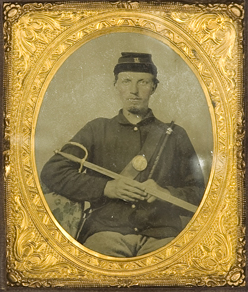
Picture of a Civil War Fife Major
Photo Credit: http://www.ohiocivilwar150.org/
My 2012 sensibilities do not allow me to comprehend why William E. Probert, the head of the family, would leave his family in the spring of 1836, to be a "Fife Major" in the War for Texas Independence. His wife, Mary, would somehow have to manage with a newborn and three other children on her own. So here are some facts:

  • At the time of William's departure from Lexington, he was 46 years old.
  • He was working as a tailor. 
  • I don't know how dangerous it was to be a "fife major".
  • I can only speculate about his motives, but maybe he wanted adventure and the hope for land should they succeed.


Thankfully, the State of Texas appears to have wonderful archives.  I was able to go to their site and search items saved from the "Republic of Texas."  Imagine my excitement when a search on "Probert" turned up several documents that discussed William's service in the War for Texas Independence.

https://www.tsl.state.tx.us/apps/arc/repclaims/

For William, just getting to Texas proved to be a challenge. According to this document:
Said Probert came with us to New Orleans and was left there in consequence of sickness. Came on to the Army in Captain Sovereign's company and then joined our company which was his (original?).
He made a commitment for six months of service and received an Honorable Discharge. What was most interesting to me was that the record included a personal description of W. E. Probert.


Transcription: To all whom it may concern, know ye that W.E. Probert, Fife Major of Captain Love's Company of Volunteers 1st Regiment 1st Brigade was enrolled on the 4th day of June one thousand eight hundred and thirty-six to serve six months and is hereby discharged from the Army of Texas. Said Probert is five foot six and a half inches high, forty-six years of age, complexion fair, gray eyes, occupation when enrolled Jailor. Given this day of December 1836.

So now I know he only committed to six months of service. I guess his wife, Mary, could survive that commitment if the rewards for service were enticing enough.  That is, if he returned home.  But the evidence doesn't suggest that . . .

Thursday, June 14, 2012

War of Texas Independence


Recently I revisited a family line that I'd left dormant for a while. I offered to try to help my cousin, Barbara Pharo, document members of her family that would qualify for the Hamilton County Century Families lineage recognition.  Thomas H. Probert is our common gg-grandfather.

Gathering the required documents led me to try to "prove" that William E. Probert is his father.  We have substantial evidence, but nothing that would yet qualify as "proof."

What an adventure! I searched for the Probert surname on the kentuckiana digital library site. This site has many digitized Kentucky newspapers.  One of the results puzzled me.


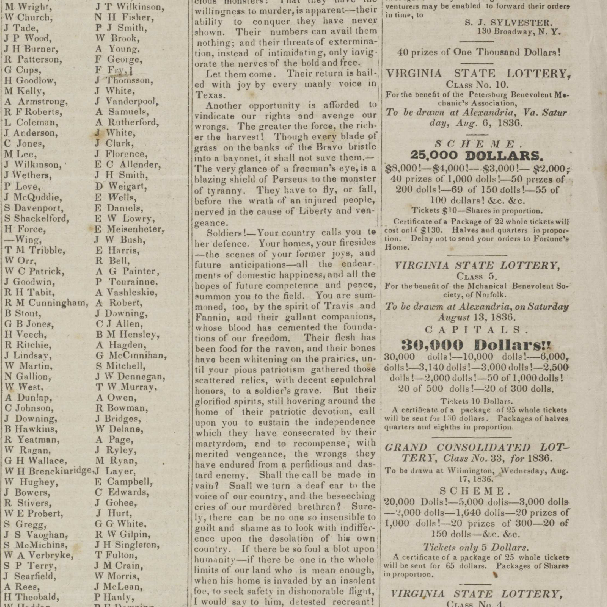
Kentucky Gazette, Lexington, Kentucky, July 25, 1836

The first shock was seeing W.E. Probert, my ggg-grandfather, on a list dating back to 1836. The second surprise was reading that the list was for Texas Emigrants:  "The following are the names of those Texas emigrants, under the command of Col. Wilson, who left New Orleans for Texas." What?

I "remember the Alamo", but I was at a loss as to why 100+ Lexingtonians would volunteer for service in the War for Texas Independence.  And so a new area of research opened up. For those of you who, like me, are not entirely up on your Texas history, here is a brief timeline:


  • 1821 - Mexico gains independence from Mexico.
  • 1821-34 There is increasing tension between the citizens of Mexico and the ever-increasing anglo population.
  • 1834 - General Santa Anna, dictator of Mexico, changes laws to the detriment of immigrants.
  • 1835-36 Texans declare independence from Mexico.
  • 1836 - Texans sign a peace treaty with Mexico and establish the "Republic of Texas." Sam Houston becomes the first president of the Republic.
  • 1845 - United States President Polk signs papers allowing the Republic of Texas to be annexed to the United States.
  • 1861 - Texas joins the Confederate States of America.
  • 1866 - Texas rejoins the United States following the end of the Civil War.

I had questions.  The answers surprised me.  

Next post: What I learned about W.E. Probert's service in the War of Texas Independence.


Wednesday, June 13, 2012

My Cousin, Steve Hansen

I am the oldest of 25 grandchildren on my maternal side of the family.  On June 10th, we lost the first cousin of this generation.  Steve bravely fought a very-rare form of thyroid cancer. He lived a little over a year after a heroic effort.  I can't say it any better than his family did.


Sunday, May 13, 2012

Why I Can't Grow Roses . . .

Three Bucks in My Backyard
It's Mother's Day 2012!  I'm happily recovering at home from the National Genealogical Society Conference that was held in Cincinnati this year.  I stayed in a downtown hotel with my cousin, Barbara Pharo, and had the opportunity to meet several of the bloggers I follow in person.  It was a great week!

At 4:30, I decided it was time for a glass of wine. Imagine my surprise when I looked out my kitchen window and saw three bucks staring back at me!  Over the years, I've tried to grow roses, only to come out and see that they have been nicely nibbled by the deer that frequent our neighborhood, but not typically so early in the day.


They patiently waited for me to switch out lenses so I could capture them close up.  It's hard to be mad at them when they are standing there so majestically checking them out.  Unfortunately, I opened the storm door to get a picture that did not include the screen. At that point, our little poodle Zippy, decided to take them on. Here is a picture of one of them trying to make a hasty exit.

Departing

Zippy meets Andrew


Needless to say, it's a good thing that the deer ran away as Zippy ran out of the door to take them on.  He does look ferocious, doesn't he? Happy Mother's Day to all.


Thursday, May 3, 2012

Vonderheide Wyoming Home


Home of August and Anna Vonderheide (1920-1925)
Village of Wyoming, Hamilton County, Ohio

I've always been fascinated by this house.  Research has shown that my great-grandfather, August Vonderheide, moved into it sometime in 1920.  It is the residence listed in the phone book as their home from 1920-25.  It makes sense that they would have wanted to move into a bigger home at this time because it coincides with the marriages and the starting of new families, all of whom initially lived there.

My grandmother and grandfather, Virginia Vonderheide and Roy Ryan, celebrate their wedding day there on September 1, 1921.  Virginia's brother, Val, also moved in with his wife, Clara Wheeler about that time. My mother, Virginia, and Val's daughter, Dolly, were born while living in that home.

I've always cherished my grandparent's wedding pictures. I recently upgraded my photo-editing software to Photoshop Elements 10 and decided to try my hand at layering these treasurers over the one picture I have of the home.  Here are the results:

Roy Ryan and Virginia Vonderheide Courting

Wedding Guests:  Top Row: Ray Ryan, Virginia VDH, Roy Ryan, August VDH, Anna VDH, Rose Gross Ryan, Clara, Emma Woermann, Victor Becker, Ed Woermann, Julius Gross, Henry and Joe VDH  Bottom Row: Florence Ryan, Josie Turner, Aunt Sophie, Ceal VDH, Emma Huff and Woermann Children

Wedding Day:  Virginia and Roy, September 7, 1921

Of course, their marriage led to the inevitable birth of my mother, Virginia, on July 17, 1922.  Here she is pictured on the porch with her father and grandparents.

Anna, Virginia (baby), Roy, August 
I'd love to show you what the house looks like in 2012.  The address of this home is 416 Springfield Pike, Wyoming, Ohio (a suburb of Cincinnati with many large, stately, restored homes). However, in the 1960s, this property was combined with a couple of others and torn down. Replacing it is a very sterile, uninteresting building that houses the Wyoming Board of Education.

Current home of the Wyoming Board of Education

I want to acknowledge my Vonderheide cousins who had a copy of the house in their collection and made it available to me.

Update:  A reader suggested that I combine pictures 2, 4 and 5.  What a great suggestion!  From right to left I now have my grandparents courting, getting married, and their first-born child, my mother.  Love it!