Thursday, November 4, 2010

The Role of the Church


One of the things that amazed me was the beauty of the churches. These were rather small communities and I could not believe the architecture and intricacy of the altar pieces and stained glass windows. As it ended up, much of the land was owned by the Church. The peasants were landless and farmed the land, paying rent to the Church. This guaranteed a steady source of income.


In present day Germany,churches are supported by a "Church Tax." The following explanation was found on wikipedia:

About 70% of church revenues come from church tax. This is about €8.5 billion (in 2002).

Article 137 of the Weimar Constitution of 1919 and article 140 of the German Basic Law of 1949 are the legal basis for this practice.

In Germany, on the basis of tax regulations passed by the communities and within the limits set by state laws, communities may either

  • require the taxation authorities of the state to collect the fees from the members on the basis of income tax assessment (then, the authorities withhold a collection fee), or
  • choose to collect the church tax themselves.

You can follow the links for a more comprehensive explanation.

Werner told us that many in Germany choose not to be a part of a church to avoid paying the tax. However, if you do not belong to a church, you may not get married, buried or participate in other religious functions of the church. You pay or you don't play.

The original Sts. Peter and Paul Church was constructed in 1827. Previously, residents of Holdorf attended church in the nearby town of Damme. The original church was very simple by comparison to the new one. The nearby town of Steinfeld applied for a grant and was able to tear down and rebuild the church for a multi-purpose use. One floor of the former church is a tannery museum. After the new church was built, there was a period of time when the building was used as a tannery. The second floor houses local records, a meeting room and is part of the Historical Society. Werner's nephew is mayor of the town and took us on a tour of the building.

Interestingly, the original doors of the church were recovered and are now on display on the second floor. They had served as doors to a tavern for many years.


I was so happy to see the baptismal font so prominently situated in Sts. Peter and Paul Church. I have every reason to believe that my g-grandfather, August, and his siblings were baptized at that very font.

Past vs Present - Part II

When I see pictures of unpaved roads and what 21st Century Germans and Americans would consider to be rather primitive housing conditions, I have to remind myself that many of the same conditions existed here 150 years ago. It wasn't all that long ago, that transportation was by horse and carriage (if you were among the lucky) and indoor plumbing was uncommon -- especially in rural areas. Coming to America could, in some cases, mean exchanging one set of undesirable conditions for another. Add into the mix a new language, hostility toward new immigrant groups, a country recovering from deep divides between north and south and I find myself in awe of my ancestors.

When Bill and I went to Germany, we were fortunate to be introduced by Werner Honkomp to the Mayor of Holdorf, Bernard Echtermann. He gave us a copy of a book, written in German of course, that chronicled the history of the region. These pictures give you a better feel for the area in the early 1900s.


This is a picture of Holdorf's Main Street. Note the church steeple on the right. This is the steeple of St. Peter and Paul's Church. The street is now much wider, the trees are no longer there, and the street is paved. The first picture below on the left shows the buildings that replaced the two on the left side of the street that burned down. The picture on the right shows the current street scape leading up to St. Peter and Paul Church.


Very close to Holdorf is a farming community called Fladderlohausen. Pictured in the book was a Heuerhaus from that community.


Another picture from the book shows a shoemaker making and wearing wooden shoes. Unfortunately, the picture is a little overexposed, but if you look carefully you can see the shoes. Holdorf is not far from the Netherlands and wooden shoes were part of the common attire. We were told that on Sunday mornings it could get quite noisy in the Church as parishioner after parishioner "clopped" their way to their pew.

Past vs. Present - Part I

One of the things that was most surprising to us was how the Heuerleute (non-landowning workers) live. Often they lived in what was called the Heuerhaus. This was often not much more than a barn that housed the farm animals as well as one or two families of workers. We were able to see one of the two Heuerhauses of the Lampe-Gossling farm. The one that is pictured with a red arrow, points out the location of the "haus" that had burned down and been replaced by a modern building. The black and white pictures were taken in 1930, fifty years after the Vonderheides emigrated.

We were able to see first-hand the surviving Heuerhaus, just down the street from the center of town and the Church. I am pictured with Werner and Mayor Bernard Echtermann who graciously toured the town with us.


Werner explained to us that each completed building included a carving by the main builder/architect. If you notice, you can see that this building was constructed in 1822.


We opened the door to the building and viewed what had been stalls for the farm animals. The farm owner lives in a thoroughly modern home and this building now functions as an outbuilding. I'm sure 150 years ago, the floor was not concrete.


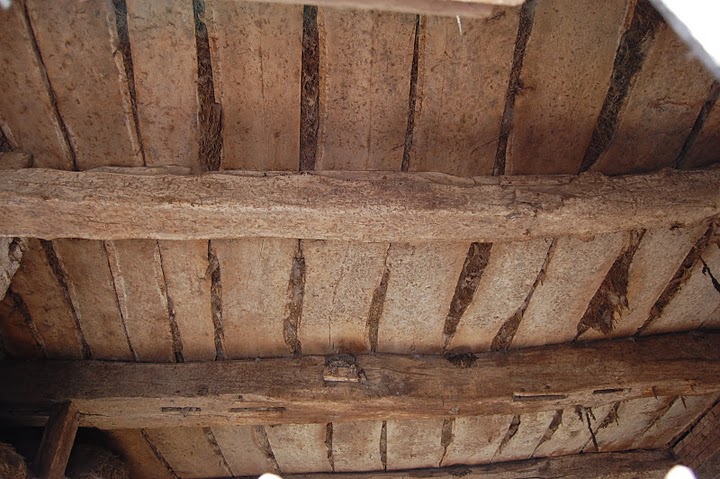
The original hand-hewn beams are visible and a tribute to the architecture of the time.


Not far from Holdorf in Cloppenburg (about 30 miles) an outdoor museum is located where many of the buildings from that era have been moved and preserved. It includes windmills, carriages, farm equipment, and living spaces so that visitors can visualize just how people of the time lived. I was especially interested in the kitchen area. Pictured below is one example of a kitchen built at one end of a Heuerhaus. Fire was a constant threat.


One common site throughout this area of Germany was a shrine with a crucifix as if the farmers were asking God's blessing upon their farms and homes. The Lampe-Gossling Farm was no exception. Here is their shrine, just outside the current family home.


Note: The black and white pictures on this post and several that follow are taken from a book on the history of Holdorf called Die Gemeinde Holdorf im Wandel der Zeit, ISBN: 978-3-86595-162-5 http://www.geigerverlag.de

Holdorf, Oldenburg, Germany

Three years ago, Bill and I had the privilege of traveling to Germany. At the time, our nephew and his wife, Christopher and Sarah were living in Frankfurt. In addition to exploring the beauty of the entire country (plus parts of Denmark), we had two primary goals: 1) visiting the home of our von der Heide ancestors in Holdorf, and 2) attending Oktoberfest with Chris, Sarah and their friends in Munich. As I look over the pictures and information collected when we were there, I long to go back. What a beautiful country!

When you travel to the "homeland", you constantly have to remind yourself that although you may be walking the same streets, it is NOT the same place. Holdorf today is a modern, up-to-date small town in northwest Germany in a country that is part of the European Union. When our ancestors lived there, Germany as a country, was just beginning to exist as a unified country.

Our ancestors came from the Duchy of Oldenburg. If you look at the naturalization papers of "Henry Vonderheide" (first and last name Americanized), Henry renounced his allegiance to the "Grand Duke of Oldenburg and the Emperor of Germany." Henry was 47 years old when he appeared in the Mayor's Court in Covington, Kentucky on November 2, 1886. He had been in this country for five years.

When Henry and his wife, Elizabeth, and their three children left Holdorf, they were near the end of a massive migration from this area to the United States. Werner Honkomp, mentioned in the previous post, helped me discover the von der Heide history in Oldenburg. I've attached a copy of the document he prepared for me. (You can probably enlarge it by clicking on the document. If you are a family member and want a copy, leave a message in the comments section and I'll try to accomodate you).


Interestingly, when a child was baptized in the Catholic Church at that time, the priest often recorded the name of the farming community where the parents lived. At times you could tell from the baptismal record if the parent was a land owner, had a cottage or worked was a non-landowning hired-hand (Heuerleute). From these records we know that Hermann Henrich (Henry) vdH was Heuerleute by Colon gr. Bolling in Holdorf at the time of his marriage. (Colon means big farmer).

Sometime between 1870 and 1873 when "Henry" and Elizabeth were having their children, they relocated to the Heuerhaus of the Lampe-Gossling farm. That farm still exists and is located right on the Gross-Strasse (Main Street) of Holdorf. The next post will include pictures of the two possible places where the young Vonderheide family lived before making the decision to emigrate.

Saturday, October 30, 2010

Back to Germany

Over the years, I have corresponded with a genealogist, Werner Honkomp, who specializes in German emigrants from the former Duchy of Oldenburg in Lower Saxony (Niedersachsen). You can click on his website http://www.honkomp.de Click on "Genealogy" and then click on the "Collection in English" found in the left-hand menu.


You can learn so much about the living conditions when the Vonderheides chose to come to the United States by exploring this site.

In the 1800s the area around Holdorf, Germany was organized in small "farming communities". Typically, our ancestors married people who lived close by. Our Vonderheide/Kamphake family last lived in the town of Holdorf. By an accident of history, the Duchy of Oldenburg was one of the few "counties" in northwest Germany that were Roman Catholic instead of Lutheran.

I was under the impression that the Vonderheides were relatively "well-off" when they left Germany. Werner burst my bubble by saying, "Get it straight. They were poor." They were "heurleute" -- basically peasants who did not own land and owed much of what they had to a landlord. Werner told me that within a period of about 50 years, 80% of the residents of Holdorf and the surrounding towns left Germany and resettled in the United States. Many settled in Cincinnati and Iowa. Many who wanted to continue farming started a new community in the Minster area of Ohio, a couple of hours north (by car) of Cincinnati.

In Germany the law required that farms be inherited by the first-born son. Thus, younger siblings had little opportunity other than farming the land of an older brother. Plots of available land became smaller with each succeeding generation. In addition, all boys were required to enlist in the army for three years of mandatory service. This combination was more than most parents could bare -- and so they left.

Werner has always told me that the Germans assumed it would take three generations in America for the emigrants to become successful. Imagine my pride when I realized just how successful my g-grandfather, August, was in such a relatively short period of time.

Friday, October 29, 2010

More Vonderheide Pictures

After my initial posts on August Henry Vonderheide and his wife, Anna Moser, I was contacted by Val and Cindy Vonderheide of Wichita, Kansas. They read of my interest in the house in Wyoming that had been torn down and replaced with the Board of Education. They dug through their family pictures and sent me several priceless pictures, including a picture of the house.

416 Springfield Pike, Wyoming, Ohio


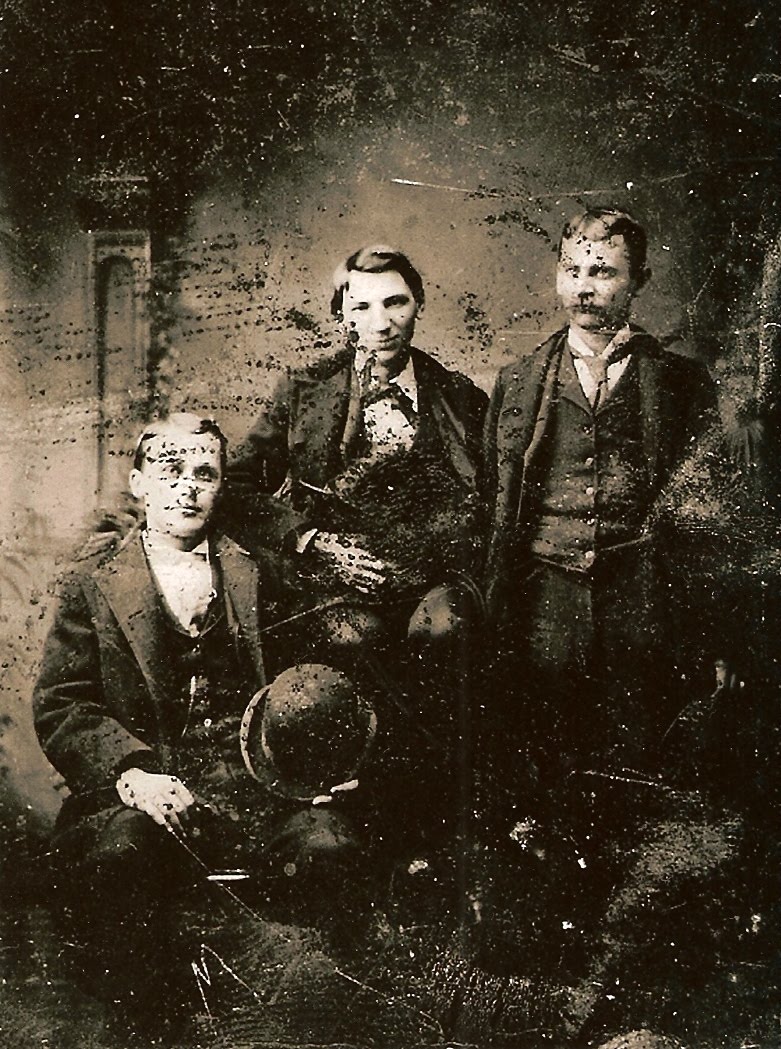
They also had several pictures of a young August and his wife, Anna -- some copied from very old tin-type pictures. In the second picture, August is in the middle. We are unsure of the identity of the other two.


In an earlier post, I had mentioned a newspaper article on the occasion of August's 80th birthday that said that August was the first clerk in the first Kroger store started by B.H. Kroger. Val and Cindy had a picture -- August is on the right, and we believe that it is Barney Kroger on the left.


They also had an additional picture of the Valley Shoe Store that appeared to be taken earlier than other pictures I have.


A long-time former mayor of Elmwood found this picture of August in his shoestore and sent it to me.


Here is a picture of Anna and August as a young married couple.


Thanks to Val and Cindy, I have enough pictures to perhaps put together a photoshow at a later date. For now, let me end this post with a picture of the entire family: Anna, August, Virginia and Val.


Note: Should you want copies of any of these pictures for your own library, you should be able to "right-click" on the image and save it to your computer.

Writer's Block

It's been two months since I've added anything to this blog. It's not from a lack of material -- it's from too much material! For sixteen days in September, Bill and I traveled to Ireland and Scotland including a visit to the Ryan ancestral home of Pallas Green, County Limerick. I could post pictures and write forever about our trip!


Shortly before we left, I ordered four Civil War Pension Records from the National Archives. I've discovered that we have six ancestors in our direct line that served on the Union side in the Civil War. I already knew about Britton Wainright, my gg-grandfather on the Jones side. You can read about him in earlier posts. Two of his brother-in-laws in the Darby family also served.

On the Ryan/von der Heide side of the family, Fred Wocker, Victor Becker and Charles Gross all served. I found out that a display in the James A. Ramage Civil War Museum in Ft. Wright, KY and the Waldschmidt Museum in Remington, OH both have displays that include listings with Fred Wocker listed on them. Mike Ryan met us at the Ramage Museum and brought a sword that had belonged to Victor Becker. Victor was the uncle of Rose Gross Ryan and is a gg-uncle to my generation. Charles Gross, a gg-grandfather, became quite ill during his service in the Civil War and was discharged due to his illness. He later was committed to Longview and died a young man. He is buried in Spring Grove Cemetery.

I found two cousins through Ancestry.com -- Betty Arnett and Barbara Pharo. Both are cousins on the Jones side of the family. Betty had priceless pictures and copies from her mother's family bible that confirmed much of what I had written earlier. Included was a picture of Britton Wainright's widow and three children. (I recently submitted an article to the Ohio Civil War Genealogy Journal about Britton's story and got it published -- including Betty's priceless picture).

Barbara and I share the same gg-grandfather, Thomas Probert. We shared research on our Mt. Sterling family. Earlier this week we visited Mt. Sterling and stayed in a wonderful, historic B&B, the Patten Everett House, that is worth the visit in itself. I've discovered some real gems about Lucy Probert Cronin, mother of Norine.


So that's my list -- each one worth a post. It's hard to keep track of all of our beloved ancestors who have proved to have such great stories. I've got to make a choice.

My plan is to write what I know about the von der Heides, taking us back to our ancestral home in Germany. From there -- we'll see . . .

Thursday, August 26, 2010

To My Faithful Followers

During the past month, I have not posted, but I have been VERY BUSY. I have so much material to compile -- in October.

I've explored additional roots and found out about three Civil War veterans in our family history. I've requested their pension files, but it takes about six weeks.

I also documented three more family members for "Settlers and Builders" status. This is a lineage society within the Hamilton County Genealogical Society. You must prove, with complete documentation, that they were in Cincinnati before December 31st, 1860. The documentation has been accepted.

The wonderful thing about this is that these records will eventually be digitized and preserved by the Cincinnati Historical Society.

In about ten days, Bill and I will be heading to Ireland and Scotland. One of the places we will visit is Pallasgrean, Co. Limerick. Our Ryans emigrated from this small town. I wish we had more time than we do to explore these beautiful countries, but I am grateful for the opportunities we have.

Just say a prayer that we both stay well and out of trouble. I can't wait to get back to this blog and share with all of you all of the new information I have collected. Love . . .

Kath

Sunday, July 25, 2010

Before I Move On . . .

I have a few pictures that I've not been able to fit easily within other posts -- but I don't want to move onto a new topic without including them. Here are some of my favorites.

This picture is taken at Virginia and Roy Ryan's home at 6385 E. Galbraith Rd. before the porch was enclosed. I don't ever remember seeing my great-grandfather dressed casually. He always looked sharp. I'll have to check with my brother, Tim, to see if he recognizes the car. (Tim just called. He said that G-Grandpa is standing in front of Charles McCafferty's 1953 Green Ford. He also said the car in the garage on the right is a 1956 Buick Grandma had. I have no idea how he does this).


Pictured from left to right starting at the top: Val VDH, Sr., Roy Ryan, Clara VDH, Dolly VDH, Val VDH, Jr., August VDH, Gus VDH, Bob VDH, Virginia, Virginia VDH Ryan, and Evelyn.


The picture above contains Hansen and Ryan grandchildren pictured with Roy and August. From top to bottom, and left to right: Carol, Bill, Roy, Patty, Pam, August, Peggy, Terry, Diane and Jim.


Evey, Mary Ellen and I worked to identify all of the cousins pictured. Bottom row: Kathleen, Evelyn, Chuck, Mary Ellen, Bill, Carol. Top row, it is Diane, Tom Karen, Roy, Jim, Patty, Tim. Lesson learned -- label your pictures!


This picture shows Anna Vonderheide holding her granddaughter Virginia (my mother) with Roy and August. I just hate it that that house was torn down.

Finally, here is a picture of August Vonderheide. His parents made the right decision to come to America.

Saturday, July 24, 2010

Anna Moser Vonderheide

The picture to the left was cropped from the family picture of the wedding of my grandparents, Roy and Virginia. It was taken in the yard of their beautiful Wyoming home on Springfield Pike that was torn down to build the Wyoming Board of Education Building.

When Roy and Virginia got married, they continued living in her family home. Virginia's brother Val married Clara Wheeler, and they, too, lived in the family home. Within a couple of years, Virginia gave birth to my mother, Virginia, and Clara gave birth to a daughter, Dolly. Pictured is Anna holding her new granddaughter, Virginia.

Virginia was anxious for her young family to move into their own home. Aunt Evelyn tells me that Roy was only too happy to stay because Anna was a great cook. They rented a home in Carthage before buying their family home in Wyoming. Anna eventually had 8 grandchildren. Here she is picture with the first six.

Pictured from left to right are: Florence, Virginia, Dolly, Evelyn, Val and Jim.

My mother always spoke of such fondness of her grandmother, Anna. Unfortunately, she died at the young age of 54 of uterine cancer. She died on March 7, 1931 when my mother was only 8 years old. She is buried next to her husband, August, at Mother of God Cemetery in Covington, Kentucky. August was a widower for 28 years.