Welcome to my blog -- Jones Family Matters. Over time, I hope to post stories, pictures, etc. from all of my family lines. The initial posts will be about the Joneses, but I've researched my German, Irish and English roots, too. Surnames I've investigated include: Jones, Ryan, von der Heide, Cronin, Probert, Dailey, Wainright, Reed and Hellmann. I've spent the past year researching my colonial ancestors and hope to share what I've learned throughout 2016.
Saturday, February 7, 2015
Probert Elected Jailer!
Friday, February 6, 2015
Time to Find a Different Job
Thursday, February 5, 2015
An Equal Opportunity Liquor Supplier
Wednesday, February 4, 2015
Making Ends Meet -- Probert Style
![]() |
| Credit: McCord Museum |
It was January, 1862. The Civil War was really gearing up. His income from the "confectioner" shop may have been suffering with so many breadwinners consumed by the war. But Thomas found a way.
A visit to the Kentucky Archives quickly uncovered multiple indictments for Thomas. His home was frequently the venue for illegal card games, gambling, and serving liquor without a license. In the case below, Thomas was indicted for "issuing unlawful money,"
Both Thomas and his wife were cited. The Plaintiff alleged that "through the fraud of the Defendant, he was induced to sign the note." Initially, the Proberts were found guilty. However, on appeal, the original decision was overtuned and the judgment was set aside.
As we will see, this was not the first or the last time that Thomas would find favor from the courts.
Tuesday, February 3, 2015
Who Was Col. Speed Fry?
Since I first discovered the children of Kate and Thomas Probert, I couldn't help but wonder why they would name their son Col. Speed Fry. I don't know why it didn't occur to me to "google" that name until today. I should have done it a whole lot sooner because it explained a lot.
Recall that Col. Speed Fry Probert was born on February 14, 1862 -- just as the Civil War was gearing up. He was named after Col. Speed Smith Fry who served on the Union side of the Civil War. For those of you who may not be aware, most of Kentucky was pro-union at the beginning of the Civil War and pro-Confederate by the end. Although the issue of slavery became one of the main issues by the end of the war, it hadn't started out that way.
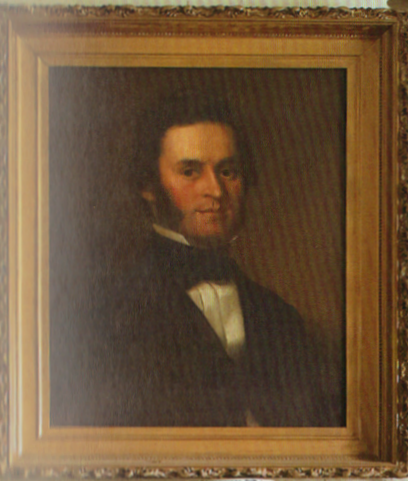
You may recall that a member of Thomas Probert's defense team, Garrett Davis, was a pro-Union man who was totally against secession. By the end of the war, this owner of 15 slaves had become completely disillusioned with the war and later ran for the Senate as a Democrat -- not the party of Lincoln.
Such was not the case with Col. Speed Smith Fry. Col. Speed Fry was responsible for raising the 4th Kentucky Infantry. He played a major role in the Battle of Mill Springs which ended up being the first major Union victory of the war. The battle took place on January 19, 1862 -- about four weeks before the birth of Thomas and Kate's son. Col. Speed Fry was given credit for killing the Confederate General during some confusion. Apparently, General Zollicoffer mistakenly thought Col. Speed Fry was a Confederate. He rode right up to the Col. and accused him of shooting at fellow Confederates. By the time this mistake was recognized, the General had been fired upon and killed instantly. There is a lot of information available, often not consistent, about the details of this battle. But one thing was clear -- it was a victory for the North.
I can only imagine that this victory was important to the Proberts as they thought the colonel would be an appropriate namesake. In addition, this research leads me to conclude that the Proberts, at least initially, favored the Union position.
Things were definitely getting off to a rough start in Mt. Sterling. It had to get better.
You may recall that a member of Thomas Probert's defense team, Garrett Davis, was a pro-Union man who was totally against secession. By the end of the war, this owner of 15 slaves had become completely disillusioned with the war and later ran for the Senate as a Democrat -- not the party of Lincoln.
| Credit: Wikipedia |
Such was not the case with Col. Speed Smith Fry. Col. Speed Fry was responsible for raising the 4th Kentucky Infantry. He played a major role in the Battle of Mill Springs which ended up being the first major Union victory of the war. The battle took place on January 19, 1862 -- about four weeks before the birth of Thomas and Kate's son. Col. Speed Fry was given credit for killing the Confederate General during some confusion. Apparently, General Zollicoffer mistakenly thought Col. Speed Fry was a Confederate. He rode right up to the Col. and accused him of shooting at fellow Confederates. By the time this mistake was recognized, the General had been fired upon and killed instantly. There is a lot of information available, often not consistent, about the details of this battle. But one thing was clear -- it was a victory for the North.
| Credit: www.millsprings.net |
Things were definitely getting off to a rough start in Mt. Sterling. It had to get better.
Labels:
Col. Speed Fry,
Hon. Garrett Davis,
Mill Springs
Monday, February 2, 2015
A Fresh Start in Mt. Sterling, Montgomery Co., Kentucky
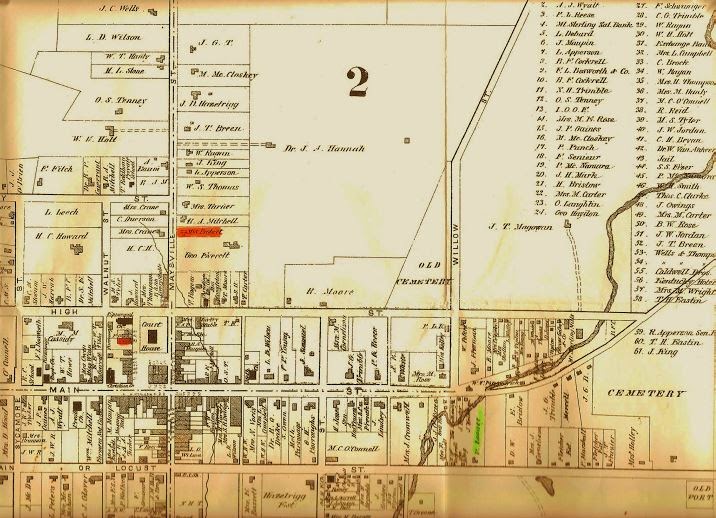
| Map of Mt. Sterling, 1879 |
If you recall, Thomas began his career in Lexington as a "confectioner." This was the trade he took up in Mt. Sterling.
According to a History of Mt. Sterling, Kentucky,
. . . the earliest baker to build a significant reputation in the community was Thomas Probert, who was in Mt. Sterling by 1859. By 1871 he was listed as a confectioner and liquor dealer, and apparently went completely in the liquor business after that." p.184)There are no records nor mentions in the newspapers in those first couple of years. On March 18th, 1860, Bettie B. was added to the family, joining two older half-sisters. This was "Kate's" first child. Unfortunately, their time of great joy was to be short-lived, as Bettie died seven months later. A son, Col. Speed Fry, was born on February 14th, 1862. Col. Speed Fry was Thomas' first surviving son -- but he, too, would die young, living only 3 1/2 years. Maggie O. was born in 1864, but would also die just short of her first birthday. Col. Speed Fry and Maggie died within two months of each other. Kate, stepmother to Addie and Lucy, was yet to have one of her own children survive to the age of four. I can't imagine the pain.
| Sleep little darlings, sleep. Not in the cradle bed. Not on the Mother's breast But with the quiet dead. |
History of Mt. Sterling, Kentucky, 1792-1918. Carl B. Boyd and Hazel Mason Boyd, 1984.
Labels:
Bettie Probert,
Col. Speed Fry Probert,
Kate Probert,
Maggie Probert,
Mt. Sterling,
Thomas H. Probert
Sunday, February 1, 2015
Past, Present and Future?
![]() |
| 1982-2015 |
![]() |
| A Flexible Flyer sled, from 1936, within the permanent collection of The Children's Museum of Indianapolis. Credit: Wikipedia |
Fast-forward to 1982 and I was a single parent to Elizabeth and had recently started dating my now husband, Bill Reed. Bill had some skills, and I wanted to have him rehab the sled for Liz at Christmas. Bill replaced a couple of the boards and varnished the whole thing. We also wrote to the company that made the sled and they provided us with a new "Flexible Flyer" decal. The first two pictures on the upper left include Bill, me and Liz when we gave the sled to her. I'm sure it meant more to me than it did to her. It brought back memories of my Dad.
When our first grandson, Ian, came along, we decided to pass it on to him. I cherish the picture of Bill with Ian making final adjustments to the sled. It snowed here in Cincinnati, and Liz, Roland and Ian took advantage of the fresh snow with the old sled. Ian, in the pictures with the brown hat, delighted in this new experience -- as did Grandma with camera in hand.
So on January 31st, 2015, new pictures arrived in my inbox. Andrew, pictured on the bottom right in a blue hat, clearly loved his ride on the sled. Pictures of Ian on the "new" green plastic sled were also included, as well as a couple of videos. I guess I'm sentimental, but these traditions mean far more to me than any other kind of gift. On this date, I am grateful for my many blessings.
Labels:
Andrew Varga,
Bill Reed,
Flexible Flyer,
Ian Varga,
Liz Varga,
Roland Varga,
sled
Saturday, December 20, 2014
Tuesday, September 23, 2014
It's Time to Recap
We're about to begin a new chapter in the life of Thomas H. Probert. As discussed in a previous post, Thomas was acquitted of the murder of Jacob Spears in February, 1859. The actual shooting took place in April, 1856, so this had consumed his life for almost three years. I have no information on how (or who) took care of his two daughters during his time in jail and while he was out on $2500 bail. At the time of his acquittal, his two girls, Addie and Lucy, were eleven and six years old.
I think that 21-year old Catherine "Kate" Probert may have had something to do with the girls' child care. Kate was born in Paris, Bourbon Co., Kentucky and was almost 13 years younger than Thomas. The Louisville Daily Courier carried the news of Thomas' acquittal on February 12, 1859.
On February 22, 1859, just ten days after the acquittal, Kate and Thomas were married in Paris, Kentucky. They took up residence in Mt. Sterling, Montgomery Co., about 15 miles from Paris. A fresh start in a new town was just what was ordered.
Sources
I think that 21-year old Catherine "Kate" Probert may have had something to do with the girls' child care. Kate was born in Paris, Bourbon Co., Kentucky and was almost 13 years younger than Thomas. The Louisville Daily Courier carried the news of Thomas' acquittal on February 12, 1859.
On February 22, 1859, just ten days after the acquittal, Kate and Thomas were married in Paris, Kentucky. They took up residence in Mt. Sterling, Montgomery Co., about 15 miles from Paris. A fresh start in a new town was just what was ordered.
Initially, Thomas appeared to support himself as a baker. According to a History of Mt. Sterling, Kentucky,
. . . the earliest baker to build a significant reputation in the community was Thomas Probert, who was in Mt. Sterling by 1859. By 1871 he was listed as a confectioner and liquor dealer, and apparently went completely in the liquor business after that." p.184)This was an occupation Thomas had also practiced as a young man in Lexington. So what would be the new chapter Thomas and Catherine would write in Mt Sterling?
Sources
"Kentucky, County Marriages, 1797-1954," index and images, FamilySearch (https://familysearch.org/pal:/MM9.3.1/TH-1-9999-17840-48?cc=1804888 : accessed 23 Sep 2014), 004542764 > image 217 of 343; citing Madison County Courthouse, Richmond.
History of Mt. Sterling, Kentucky, 1792-1918. Carl B. Boyd and Hazel Mason Boyd, 1984.
Tuesday, August 5, 2014
How to "Preserve Your Honor" by Having a Duel
Over the past few months, I have read a lot about the "tradition" of challenging someone who has "insulted" you by challenging them to a duel. It was considered to be part of the "honor code." If a "challenge" was offered, you had to respond or your "manhood" would take a hit. If you are as curious as I was about this topic, you can read some of the rules for dueling. If you understand the "honor code" of the time, you have a better idea of why Jacob Spears felt he had to defend his honor with a duel after Thomas Probert told him "not to show his backside."
The last two posts discussed the powerful men who served on the prosecution and defense teams for the trial of Thomas Probert. The whole tragedy of the death of Jacob Spears was the result of what Jacob perceived as an "insult" and the need to "defend his honor." Imagine my surprise when further research showed that five years after the trial, two attorneys involved in the trial were about to have a duel of their own!
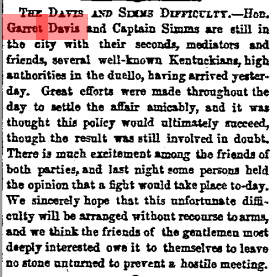
The Honorable William E. Simms (Prosecution) challenged the Honorable Garrett Davis (Defense) to a duel over comments made by Davis and reported in a newspaper article published in the Paris Citizen. According to an article in The Cincinnati Enquirer published on June 14, 1859, the "challenge" resulted from this incident:
You can read a rather lengthy exchange of letters that were published on June 17, 1859 in the Louisville Courier. The article discussed a "Difficulty Between Capt. Wm. E. Simms and the Honorable Garrett Daivs. What's fascinating to me is that, in an effort not to break the law in Kentucky, they both agreed to hold the duel in Cincinnati.
| Jacob Spears |
The Honorable William E. Simms (Prosecution) challenged the Honorable Garrett Davis (Defense) to a duel over comments made by Davis and reported in a newspaper article published in the Paris Citizen. According to an article in The Cincinnati Enquirer published on June 14, 1859, the "challenge" resulted from this incident:
| The Cincinnati Enquirer, June 4, 1859, p. 2. |
You can read a rather lengthy exchange of letters that were published on June 17, 1859 in the Louisville Courier. The article discussed a "Difficulty Between Capt. Wm. E. Simms and the Honorable Garrett Daivs. What's fascinating to me is that, in an effort not to break the law in Kentucky, they both agreed to hold the duel in Cincinnati.
| The Cincinnati Enquirer, June 21, 1859, p. 4. |
Luckily for all concerned, cooler heads eventually prevailed. With the mediation of several "friends" and representatives of the two men, the complaint was eventually withdrawn. The Louisville Daily Courier published the following resolution to the "difficulty" in its June 23, 1859 edition:
Ironically, Garrett Davis later signed legislation forbidding duels as a means of resolving differences in Kentucky. Even today when the Governor of Kentucky is sworn in, part of the oath requires that he/she swear that they have not and never will participate in a duel. "The times they are a'changin'." Bob Dylan
Labels:
code of honor,
duel,
Hon. Garrett Davis,
William Simms
Subscribe to:
Posts (Atom)